In January 1994, Mark Benthien was just an undergraduate student studying applied geophysics at UCLA. He had a passion for earthquake science and hoped to one day make a career out of helping people prepare for earthquakes. On the morning of the Northridge Earthquake, he was sound asleep when the powerful shaking shook him awake.
“I remember my belongings were hurled across the room and scattered on my floor. I had to walk through the mess to even find my shoes,” he said.
Thirty years later, he is the director of Communication, Education and Outreach at the Southern California Earthquake Center (SCEC). Headquartered at USC, SCEC is a research organization funded by the National Science Foundation and the U.S. Geological Survey that aims to gather data on earthquakes, interpret that data and communicate those understandings to build a resilient, earthquake-prepared community. The non profit organization partners with different institutions around the world to create a virtual network of collaboration and advocacy.
As the director of Communication, Education and Outreach, Benthien focuses on making sure the public is informed and prepared for the next major earthquake. One of the largest projects he coordinates every year since its inception is the Great ShakeOut earthquake drills.
“Since 2007, we’ve taught thousands of students the proper way to protect themselves during an earthquake,” he said. “The Great ShakeOut began as a one-time, statewide event to commemorate the 15th anniversary of the Northridge Earthquake. The goal was to get as many students across the state to Drop, Cover, Hold On for one day. Now, fifteen years later, we are teaching millions of people around the world to practice this.”
Benthien also manages the Earthquake Country Alliance, a non profit organization under SCEC that attends and hosts events across California (otherwise known as “Earthquake Country”) to help communities stay informed and prepared for the next big one.
The Great ShakeOut now operates in all fifty states and U.S. territories in addition to countries like Japan and New Zealand. Additionally, anyone around the globe is encouraged to participate. While the internationally recognized earthquake drill lends most of its participation data to schools, the Great ShakeOut is open to all types of organizations, including businesses, hospitals, clinics, non-profits, local and federal government offices and many more. Benthien says the Great ShakeOut has impacted many young people across the state.
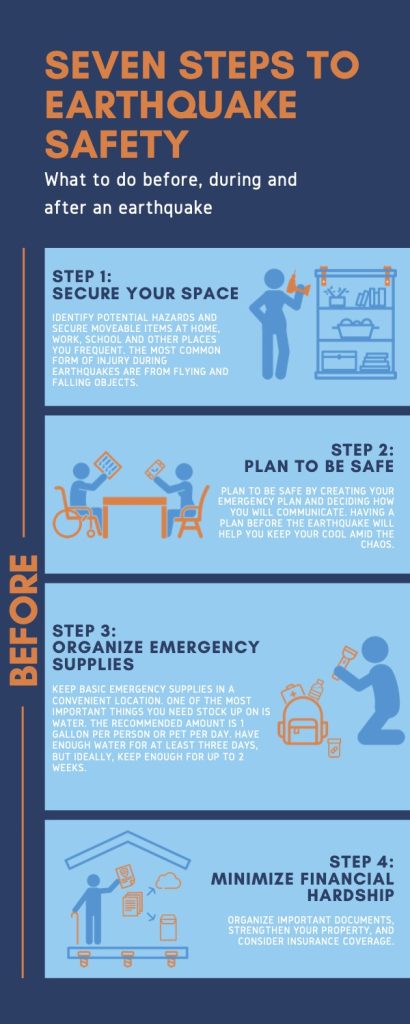
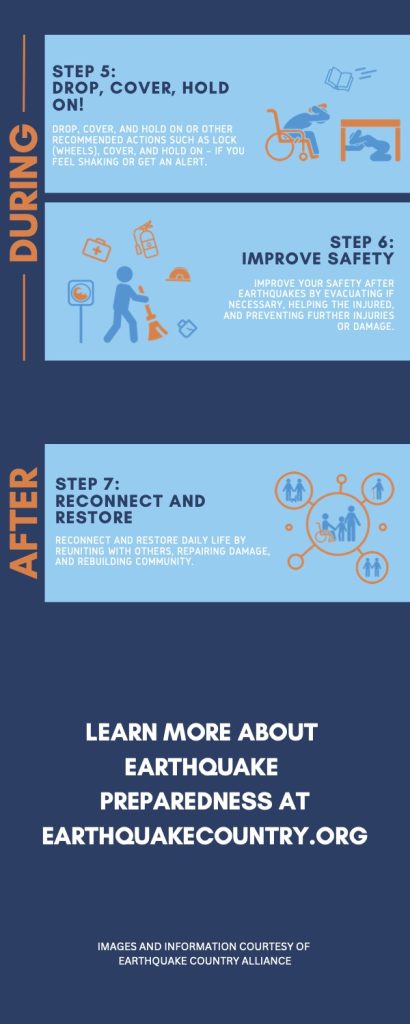
Aside from simply the Great ShakeOut, there is so much more you can do to prepare for the next big earthquake. The Seven Steps to Earthquake Safety, created by earthquake preparedness experts, is a great guide to learn what to do before, during and after a major earthquake.