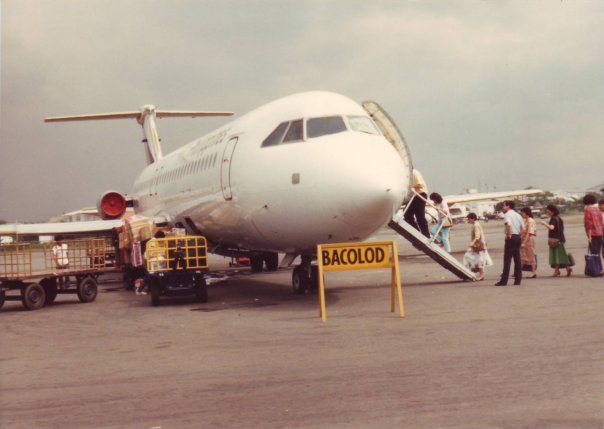
Bacolod Airport, 1978 via Rebecca Alunan on Facebook.
Bacolod is a city nestled in the western Visayas region of the Philippines. It is known for its MassKara festival and home to an abundance of sugar cane and carabao. The Manila resident may playfully refer to the city of Bacolod as closer to the country than anything metropolitan; its residents are “province folk." In Bacolod, everyone knows everyone.
This is where our story begins.
Rose was born in Bacolod, Philippines at the dawn of the second world war to a prominent and established Bacolod family. Rose was born into a nation that was both under American colonial rule and still reeling from the impact of over half a century of Spanish colonial rule. The Philippines then, as it is now, was steeped in Spanish-missionary-imposed Catholic doctrine. Her family's status in the small city and the tight grip with which they and her educators enforced Catholicism made it so Rose's life was built around building piety, maintaining status, and avoiding shame.
“When I was 12 years old, we [went] for vacation in another province where my grandparents were,” Rose says.
“So one day I opened the window because I wanted to see Mount Mayon Volcano, which is one of the wonders of the world because it is so perfectly pointed. So, I opened the window, and my grandmother says, ‘Why are you looking out of the window? The neighbors will say you are looking for a boyfriend!’”
What's more, Rose was unable to speak in her native tongue freely.
Rose recalls: “The Spanish took over the Philippines for 500 years, and then the Americans came, and that was it. My mom and dad would sometimes say to me: ‘We won’t talk to you if you don’t talk in Spanish.’” But the native Ilonggo speaker was made to speak English by her teachers.
“How can I speak Spanish when we have to speak English in school?”
Rose’s life in Bacolod, it seems, was controlled under a watchful eye. She learned to navigate the world with little autonomy, being made to be careful about what windows she looked out, what language she spoke, what clothes she wore, what occupation she chose. She accepted her life as something she had little control over. The way she navigated the world, she notes, was purely a product of her conditioning.
That is, until she learned about Bhagwan.