From endangered in England to ambitious in America, stained glass is a craft that's been through ups and downs—and in L.A., it's on the rise.
By Krystle Ehara
Cambridgeshire, England. A cathedral that was built nearly a millennium ago. The English Gothic and the weight of a dying legacy.
For Emily Allen, Ely Cathedral is a beautiful place—but one rife with reminders of what may not last. Up a spiraling stone staircase she goes, higher and higher into the upper levels of the Cathedral. It’s cloudy outside, grey and cold, but up here, the tepid sun is revived; color and light are crafted anew as Allen stands surrounded by thousands of stained glass windows.
“If things continue as they are, I think it’s only going to get worse and become a bigger problem.”
— Emily Allen
She’s in The Stained Glass Museum, the only museum of its kind in the United Kingdom. 1970s England saw the rapid closure of churches across the country—society was becoming secular, churches redundant, and the medieval upkeep was a financial nightmare. But as their doors shut, their stained glass windows were saved. Beginning as a rescue initiative in 1972, Ely slowly became home to these fragile artworks, eventually transcending borders to save pieces from across the globe and history; from England to Singapore, 1210 to 2010, the Museum found a place for them all.
Allen is deputy curator, and she places herself in a precarious position: the historical art form she’s dedicated herself to preserving is inching closer and closer to the edge in the modern day.
“If things continue as they are, I think it’s only going to get worse and become a bigger problem,” Allen said. “And it's a multi-faceted problem, so the solution is going to have to be complicated and multi-faceted as well in order to overcome that.”
Two years ago, the British national charity Heritage Crafts declared that traditional stained glass window making was officially on the Red List; officially, it is now an endangered craft.
The British Society of Master Glass Painters offered a number of reasons why: aging practitioners, a lack of raw materials, fewer apprenticeships—or, as Allen phrases it, “if you can’t work in it, you can’t learn it, and you can’t get the materials…none of that’s going to work.”
“If we lose that, we've lost a really significant part of our cultural heritage.”
— Emily Allen
Despite noticing a “massive increase” in visitorship of the Museum, she’s not entirely confident it translates into a continuing existence and appreciation of the trade. To her, it only speaks to the lack of spaces to engage with stained glass elsewhere.
“Eventually, the last stained glass maker will die out, and there won't be anyone there to replace them who's learned how to do it and keep those skills going,” Allen said. “And then if we lose that, we've lost a really significant part of our cultural heritage.”
England has long been at the forefront of traditional stained glass. At least thirteen hundred years have passed since the art first started weaving itself into the artistic culture and history of the nation, from the golden Middle Ages of cathedrals to the Gothic Revival. Even as the continent turned away from the ornate art of stained glass, England fought to keep it alive.
It may be a losing battle.
From Old Comes New
Across the pond however, a different story shines true.
“It's an entirely different ecosystem over here,” Megan McElfresh, executive director of The Stained Glass Association of America, emphasizes. “[There’s] the perception that we are a dying trade—we are still a very young trade, just like America is still a very young country.”
The U.S. is at a major preservation stress point right now. The stained glass buildings that cropped up in the Opalescent Era of the last century are at risk, but instead of fixating on the potential loss, glass here is beginning to turn towards the potential opportunities—especially in Los Angeles. In a country built on scrappy determination, the history of American glasswork is brimming with innovation and ingenuity; now, that creativity is once again coming to the forefront of the craft.
Far from the English gloom, the California sun beams into a refurbished warehouse, catching on a wall of glass and sending sparks of color splashing across vintage cars and a star-spangled banner.
It’s the new Glendale location of Glass Visions Studio, one of the few premiere stained-glass studios in Los Angeles. Founded in 1979 in Glassell Park by Mark Tuna, his son, Ben Tuna, now owns the studio. He’s the head—and heart—of the business.
Ben calls himself a kind of “young outlaw” in the trade.
“I’m trying to bring a fresh approach to the work and do stuff that people have never seen…I’m interested in seeing where this could go.”
One of his favorite projects? The new Culver City location of Bacari, a chain of Mediterranean-inspired tapas style restaurants across Los Angeles. Glass Visions just finished the work about a month ago, and the restaurant itself is still not open to the public yet; however, when it is, visitors will be greeted with “incredible pyramid skylights.” These skylights, around six feet tall a piece, are fully hand-cut, reclaimed European windows with the addition of colored glass.
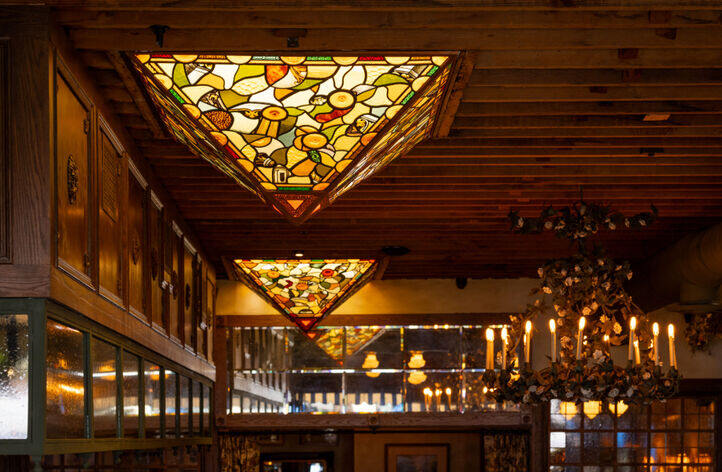
It matches perfectly with the style he’s trying to bring to his glasswork.
“I like a lot of salvage,” Ben said. “I like taking 150-year-old windows that are broken and forgotten about and rebuilding them into something architectural, while honoring all the craft that went into [them] that otherwise would not really be seen.”
A careful modernization of the medium is what has been fueling its fire in the states, he alleges.
“Design is becoming really fun right now,” he said. “We’re extremely busy with projects where the designers are letting us kind of run wild and test the boundaries with glass.”
From Bleak Comes Bright
The future of stained glass isn’t as dreary as it seems—if anything, it’s a kaleidoscope of artistic freedom.
“Because people think it's dead, people don't realize that it's an incredibly viable contemporary art form,” Megan McElfresh, executive director of The Stained Glass Association of America, said incredulously. “We're in the age of glass.”
“We're in the Age of Glass”
— Megan McElfresh
In recent years, the stained glass resurgence has been steadily growing. Architectural Digest articles fawn over "breathtaking" stained glass windows, from past Gothic cathedrals to new, "chic Parisian apartments." House & Garden says this year is the "renaissance" for stained glass in interior spaces. As Country Living phrases it, "In 2025, stained glass is officially back!"
It’s the nostalgia pendulum: the 30-year cycle back to the funky postmodernism of the 80s and 90s, the rejection of “sad beige” and the return of vibrancy, the embracing of color, light, and glass anew.
Los Angeles in particular has been making major headway in cementing itself as a critical part of this new wave of stained glass. The studio most responsible? Judson’s.
Located about seven miles away from the red vintage cars and grooving reggae tones of Glass Visions, a quiet neighborhood in Highland Park boasts both a cultural heritage monument and a national name in the stained glass industry.
A street sign will point you towards an unassuming driveway, framed by lush greenery and old asphalt. A short stroll down reveals a Craftsman-style building, with blue window frames and wooden panels; it’s charming, cozy. It’s also home to the oldest family-run stained glass company in the United States.
Judson Studios has been at the forefront of the L.A. stained glass scene since 1897. Fifth-generation president David Judson now helms the historic business, and he shares Ben's attitude towards the future of glass.
“It’s the perfect kind of recipe, the perfect place, because the West Coast has that mentality of taking something and making it new again,” Judson said.
To him, the focus on color and fun doesn’t just mark a revival of stained glass—it’s the city’s unique contribution to it.
Starting from the 1990s, when Judson began seriously working with glass, he was looking towards the next direction of the trade. It took the pressure of being a finalist in a Kansas City stained glass competition to steer away from the tradition of older, European studios.
“We needed to do something to make ourselves a little bit more contemporary,” Judson said. “We had to design something that really kind of pushed the limits, and we created a design that could not be done with traditional stained glass.”
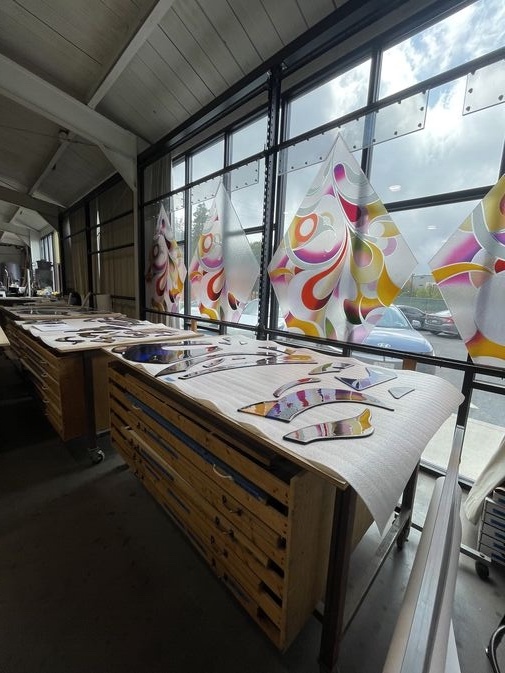
Finished project panels line the windows.
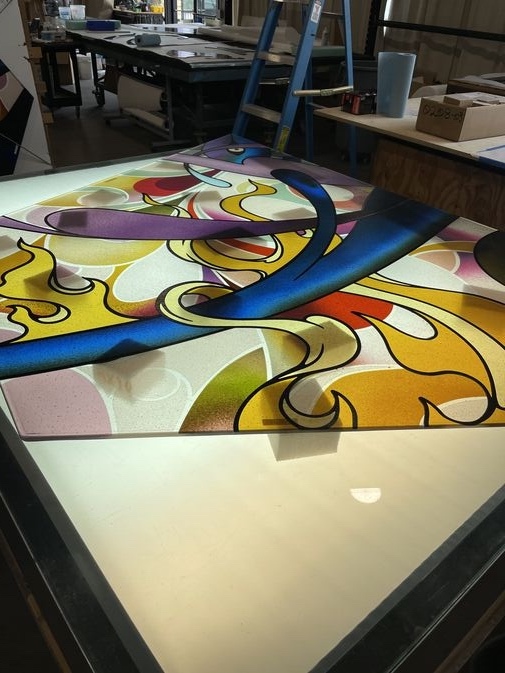
The light table illuminates fused glass.
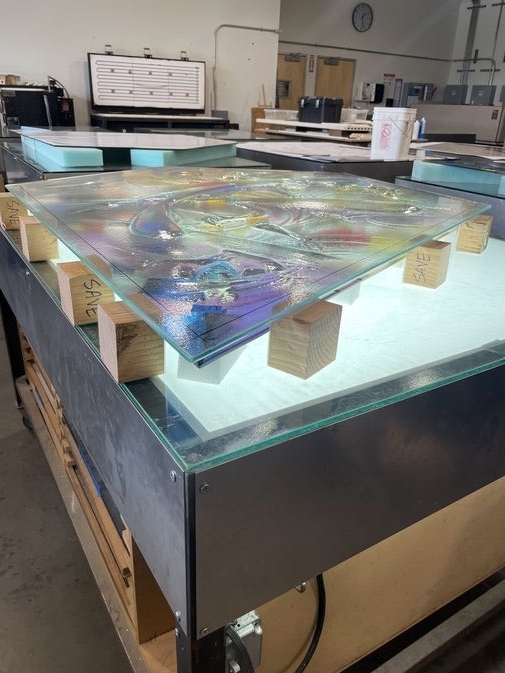
Glass is lined up with a design panel to be fused together.
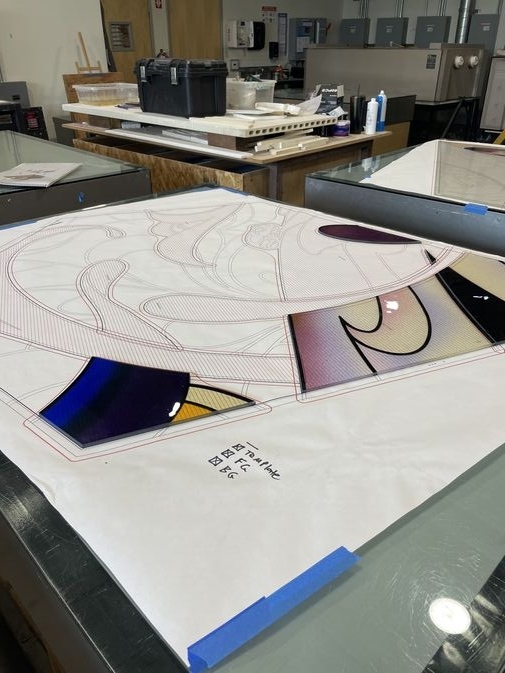
Glass is placed according to the cartoon.
The explanation to this seemingly impossible solution comes in the form of frit, power, and technology; or, fused glass. Fused glass takes frit, a ground up form of glass, and creates an entirely new sheet of glass to be worked with. The crucial difference between traditional glass and fused glass is that due to this method, different colored glasses can be put into a kiln and—as the name suggests—fused, allowing for a multitude of designs and effects within the glass.
“Traditionally stained glass, if you took different colors and fused them together, would stress and break over time,” Judson said. “But with fused glass, they have a coefficient of expansion that allows them to remain stable over time once they fuse together.”
“[It’s] really blowing up all of the existing constraints of the stained glass as we know it.”
— David Judson
Fused glass only became a possibility around the mid-1980s, when Bullseye Glass, a Portland-based glass company, created a compatible line of glasses. Judson’s expanded studio, a short drive away from their historic one, is right next to one of Bullseye’s resource center locations. Compared to the centuries of history behind traditional stained glass, fused glass is less than a lifetime old—but instead of being intimidated by the novelty of it, Judson Studio has worked to “embrace this technology that no other major studio in the world has done yet.”
“[It’s] really blowing up all of the existing constraints of the stained glass as we know it.”
From Art Comes Worship
Hidden in the history of the house is more than just stained glass. A wide window on the second floor now shines onto pieces of glass, ready to be painted—a little over 100 years ago, it illuminated models for art students at the College of Fine Arts of the University of Southern California. From 1901 to 1920, Judson Studios was the original location (and William Lees Judson the first dean) for what University Park Campus now calls Roski.
“My grandfather, my father, myself and my son have all attended USC,” Judson said. “So there's a very strong connection there.”
Haven Lin-Kirk, the current dean of USC Roski School of Art and Design, is the self-proclaimed “biggest enthusiast” of Judson Studios.
“It does something that no other material can do…it allows color to evolve through the day. ”
— David Judson
“They were always very innovative,” Lin-Kirk said. “Because they had a very close relationship with artisan craftspeople, and they were very experimental in some of the techniques that they were using—-not just at that time, but they continue to do it, even to this day.”
She cites the Caruso Center as a prime example.
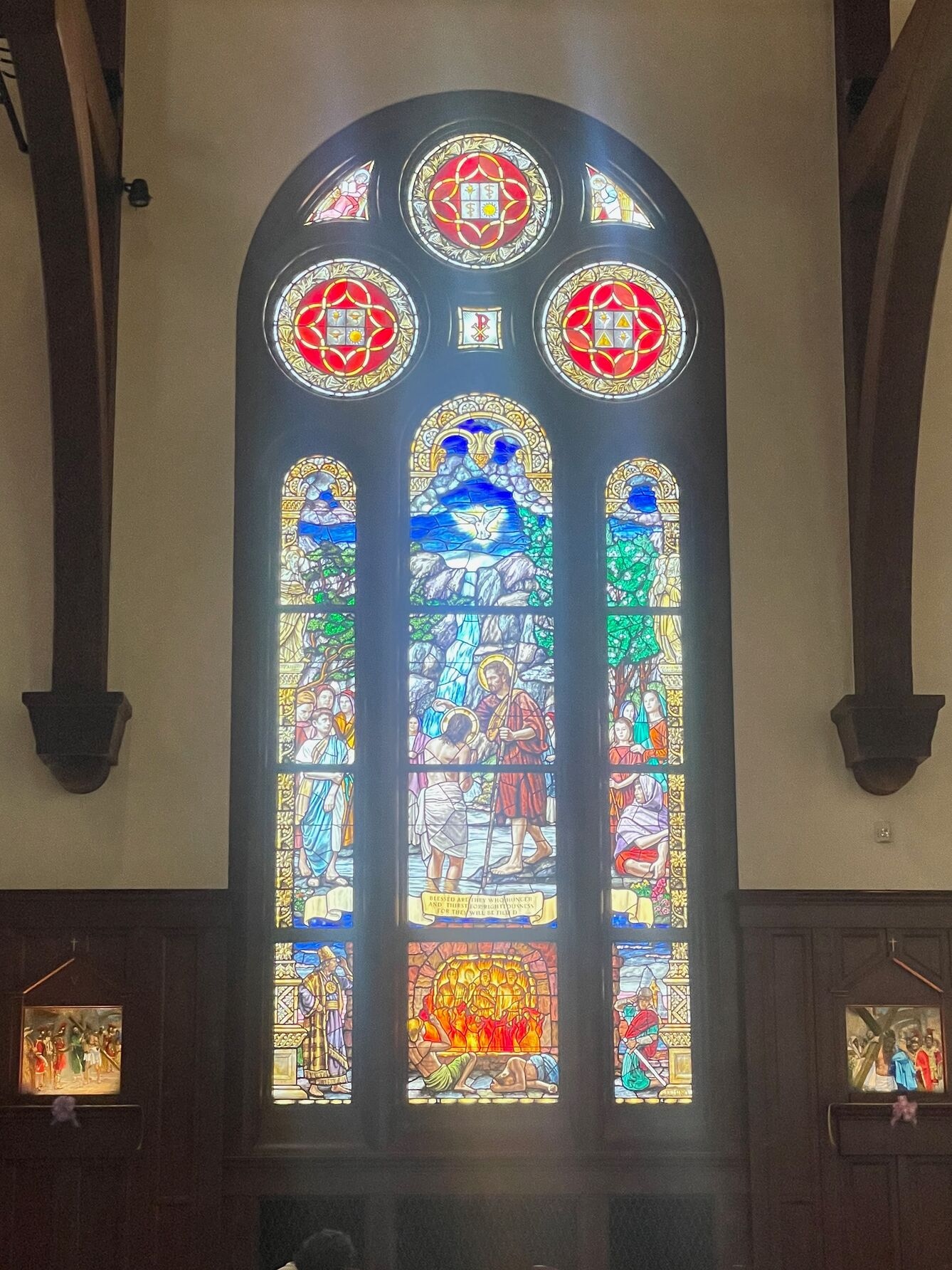
“It’s not regular stained glass, where you’re using lead and outlining things…they’ve done things with fused glass—and a painter understands this—that shows how the pigment works and color theory and all these things,” she said.
This works because glass is a distinctly unique medium. As Judson defines it, “because you're working with transmitted light, it does something that no other material can do…it allows color to evolve through the day.” The Caruso Center windows are, once again, a prime example.
1 / 4



The art does more than simply look beautiful: Lin-Kirk observes it “lifts your spirit” and McElfresh calls it a sense of “awe and peace and wonder.”
Jeffrey Weaver, the associate curator of the Department of Sculpture and Decorative Art at the Getty, agrees.
“If it's well installed, I think people can be really, really intrigued by stained glass…people spend time just sitting and contemplating and looking at them,” Weaver reflected, recalling a past exhibition at the Getty revolving around stained glass from the Canterbury Cathedral.
From Then Comes Now
Los Angeles is often seen as a land of glitz and glam—artistically, it’s also home of the opposite.
Between 1895 and 1930, a unique regional style was blooming. Drawing from the landscape, craftsmanship, and Spanish and Mexican heritage, the Arts and Crafts Movement found a place in Californian history: the Greene brothers, Charles & Ray Eames, the Arroyo culture. Nature, handmade art, and simplicity were all major themes in the sweeping art movement; moreso, a new emphasis on individuality burrowed into the Californian art psyche. For artists around the country, Southern California became the land of visionary liberty.
“People came here, did unusual things here,” Lin-Kirk said. “There's a history of creativity that kind of exists throughout this region.”
Southern California, and Los Angeles County in particular, has an intense connection with the arts. The creative economy contributes over $164 billion (in gross value) to the local economy and accounts for over 21% of all jobs in Los Angeles County according to the 2025 World Cities Culture Forum. L.A. is also home to “more working artists than any other major metropolitan area in the United States.” However, despite being a rising art capital for the better part of three decades, the city is still carving its place besides New York and London, Boston and Berlin—the east coast and the old arts.
“There's a history of creativity that kind of exists throughout this region.”
— Dean Lin-Kirk
For Judson Studios, this challenge is the motivation behind leading the charge for fused glass.
“Being in Los Angeles, it was very important to me…it’s such a creative and forward-looking city,” Judson said. “We should be on the cutting edge.”
Stained glass may be on the out abroad, but in L.A. it’s only on the up and up—and the question isn’t when glass will die but how do we make it alive? It’s the California craft, the endless opportunities of color and creativity soaking its way into the windows to an ancient trade’s soul. From style to technology, L.A. is setting aside the expectations of tradition and working towards their own version of the stained glass.
And with centuries of history at risk as glass faces an unknown future, perhaps the L.A. look is the new solution to an old problem.