In the heart of L.A.’s Chinatown, a vibrant community mall that once housed over 150 vendors now faces erasure under looming redevelopment plans. As corporate interests close in, longtime shopkeepers and residents are fighting to preserve the last stronghold of working-class culture in the neighborhood.
by Zifei Zhang
Nestled in a cozy corner of Dynasty Center, the last community mall in Chinatown, lies Mai Tu’s shop crammed floor to ceiling with every accessory you could imagine.
Custom necklaces, polished crystals, fashionable purses, Chinese tassel pendants, jade keychains, decorative wood figures — her storefront is covered wall-to-wall, display case to display case, with merchandise from her decades of entrepreneurship in Chinatown.

As you browse through the treasures that fill her shop, she acts as a guiding hand to finding your perfect piece to leave her shop with. And of course, she always makes sure you walk away from her tiny shop with a great deal.
Behind the shimmering displays and warm smiles lies a remarkable story of resilience and determination.
In the 60s, a wave of upheaval swept across China. Young Mai and her family witnessed the Cultural Revolution. They sought refuge in Vietnam only to be faced with displacement again as the Vietnam War brought turmoil to her new home.
She left Vietnam, uprooting her life again. Mai found herself in Norway in 1978 after a long journey by boat. She was alone, having become separated from her parents who made their way to Malaysia.
After nearly 5 years of separation, Mai reunites with her family in 1983 in Los Angeles. They established a life in Chinatown, opening a storefront in The Shop, a swap meet-style community mall.
The Shop was a hub for business in Chinatown.
In 2021, The Shop was converted into an office space by Santa Monica-based development company, Redcar Ltd. This followed the 2015 Redcar office space conversion of Chinatown Swap Meet, another beloved community mall sandwiched between Dynasty Center and the Shop.
Mai moved her shop to Dynasty Center, which has a similar set-up and is right around the corner to 821 N Spring St. It is the final bastion of community malls in Chinatown, the last one standing on Spring Street.
At its peak, Dynasty Center was home to about 150 sellers. The pandemic, however, took a toll on the mall — pushing out many of these legacy businesses. In 2020, Redcar bought Dynasty Center out, and the development company has pushed out all, but one of the outdoor vendors on Spring St. About 70 of vendors, including Mai, remain in the indoor booths.
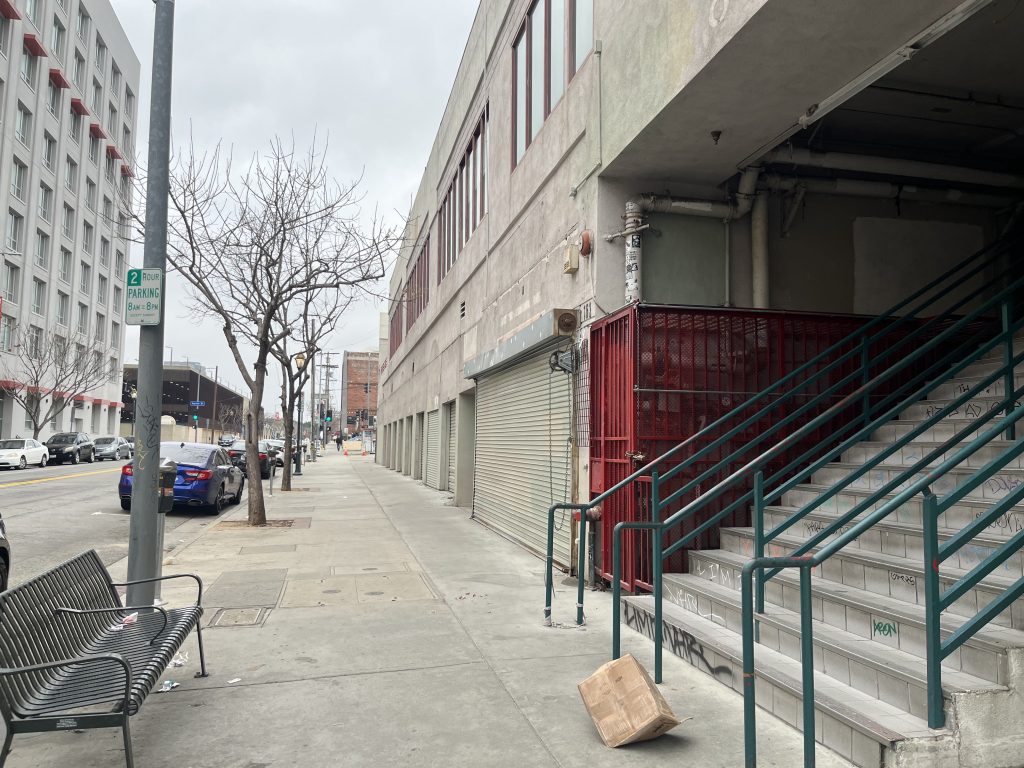
But, Mai’s fate – and the remaining small business owners inside Dynasty Center — remains uncertain.
More than a Mall
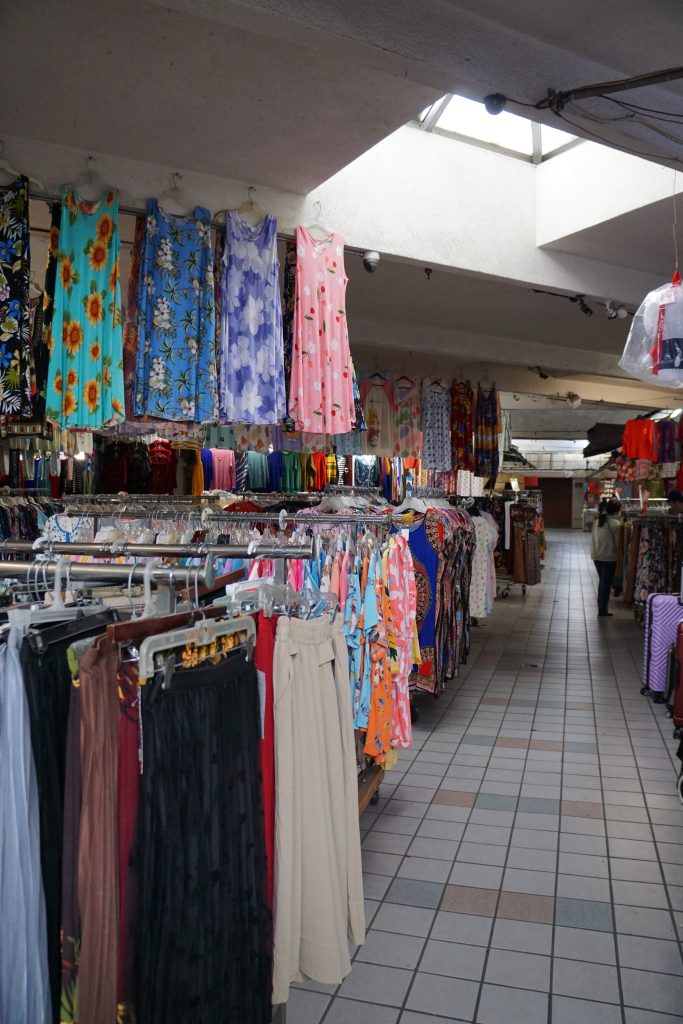
Dynasty Center is a true cultural community space. Like many shopping centers in Asia, this community mall is a vibrant maze of haggling, clothing racks, and classic karaoke songs. Corridors transform into an extension of every vendor’s storefront. Tables and products flood into walkways and old shipping containers are converted into bins selling 10 socks for $5. Walls are lined with little toys and electronic gadgets. You can buy an entire outfit at one stall and get it tailored to your liking at the next.
This shopping experience is not for everyone, but it’s one that becomes a pathway to home for many.
Nubes Chen, a community organizer with the Chinatown Community for Equitable Development (CCED), says the community mall reminds her of the bustling markets in her hometown in China and is a haven for human stories.
“Dynasty Center needs to be preserved,” said Chen. “It represents a forgotten history about Chinatown — it’s not just a community for Chinese people; there are a lot of Southeast Asian immigrants who moved to Chinatown. I think it has the preservation value to offer.”
Nestled within Dynasty Center and its adjacent alleys is a vibrant community of over 70 vendors. Dynasty Center shops provide products that span a diverse spectrum, from household wares to traditional Chinese medicine. These vendors aren’t merely sellers of goods; they also act as the economic backbone for low- and working-class residents in Chinatown and surrounding neighborhoods. Most Dynasty Center products and services are offered at negotiable or budget-friendly prices.
Elise Deng is a lifelong resident of the neighborhood, hailing from a family of Chinatown small business owners. They recall the budget staples of Dynasty Center was an integral part of her childhood.
“I grew up always going to Dynasty Center, for back-to-school shopping, Christmas shopping, and every time my family needed to get affordable things,” said Deng. “Dynasty Center was always the first stop because we knew that we could get everything that we needed there at an affordable price.”
John Tran also grew up in Los Angeles, helping out with his family business in Dynasty Center. Now, he’s taken over his parent’s luggage and bedding storefront. With a warm and welcoming personality, Tran has cultivated close relationships with his repeat customers. But with the threat of Redcar’s redevelopment, those relationships are at risk too.
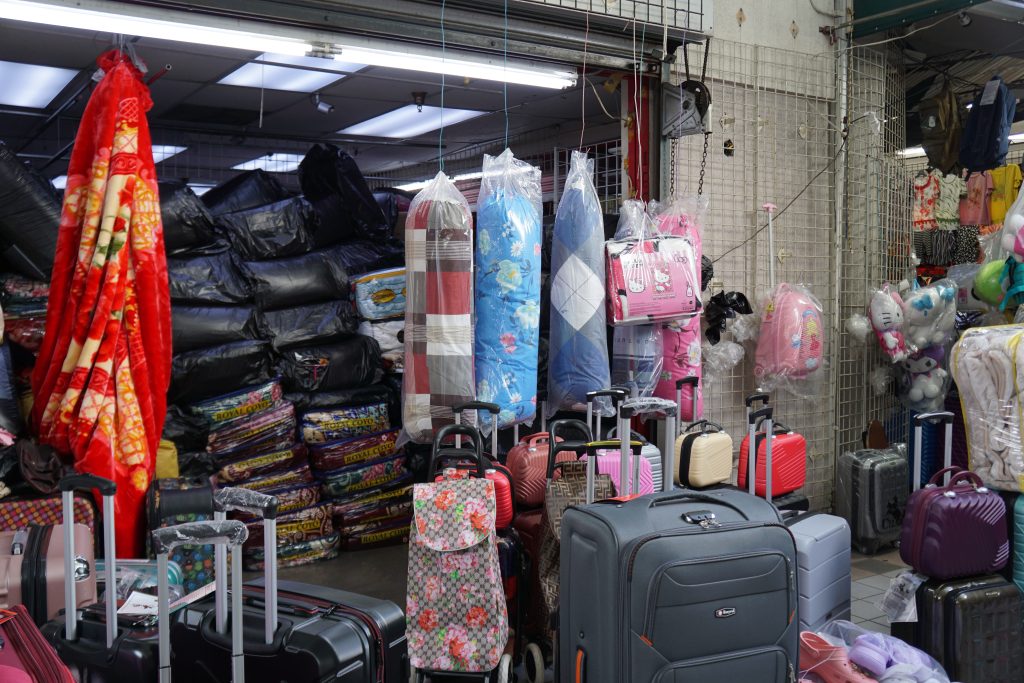
“My customers who I have developed relationships with — they won’t be able to come here anymore. It’s no longer like a community. It’s no longer enjoyable,” said Tran. “We don’t need more offices — you can just build that anywhere. There is other places, but instead, you build them in a place where small businesses thrive. It’s just horrible.”
Unlike the ghost malls across many locales in the United States, Dynasty Center is a true cultural space cultivated by and for the working-class Chinatown community.
“It’s more than just a business, you know? It’s historic. It has memories of the community, you know? People come here, and people share stories of Chinatown but once this is all destroyed, it’s no longer what Chinatown is all about,” said Tran.
A Developer’s Dream
Chinatown stands as a magnet for developers, beckoning with its promising canvas for urban transformation.
It’s in a prime location: close to Downtown L.A., boasting convenient access to a Metro Line stop and other L.A. staples like Grand Central Market, Dodger Stadium, and Union Station It may even host a gondola to the stadium.
With cheap property prices, there’s no question why luxury developers across the city are drawn to a neighborhood like Chinatown.
Redcar Ltd. is one of the major developers in Chinatown. The company has already reconstructed two properties on Spring St into generic, modern office spaces, erasing a few more pieces of the cultural tapestry of Chinatown.
Deng, a Chinatown native, is also one of the small business team leads for the Chinatown Community for Equitable Development, which not only organizes against gentrification in Chinatown but also conducts research about these luxury development companies.
“Chinatown isn’t the only neighborhood that Redcar has gentrified,” says Deng. “From our research committee’s work, we were able to find that Redcar actually owns hundreds of properties across Los Angeles, a majority of which are in the Silver Lake, Highland Park, and Loz Feliz area, which many people know have been recently gentrified in the past 20 years. A lot of the historic communities no longer live in that area of Northeast LA and Redcar just continues to expand their footprint.”
In Chinatown alone, Redcar owns nine properties, and of the redeveloped properties, all have been converted into either luxury office spaces or luxury restaurants. These spots that were once Chinatown businesses or community spaces are now unaffordable for the people of the neighborhood.
Redcar Projects on Spring Street
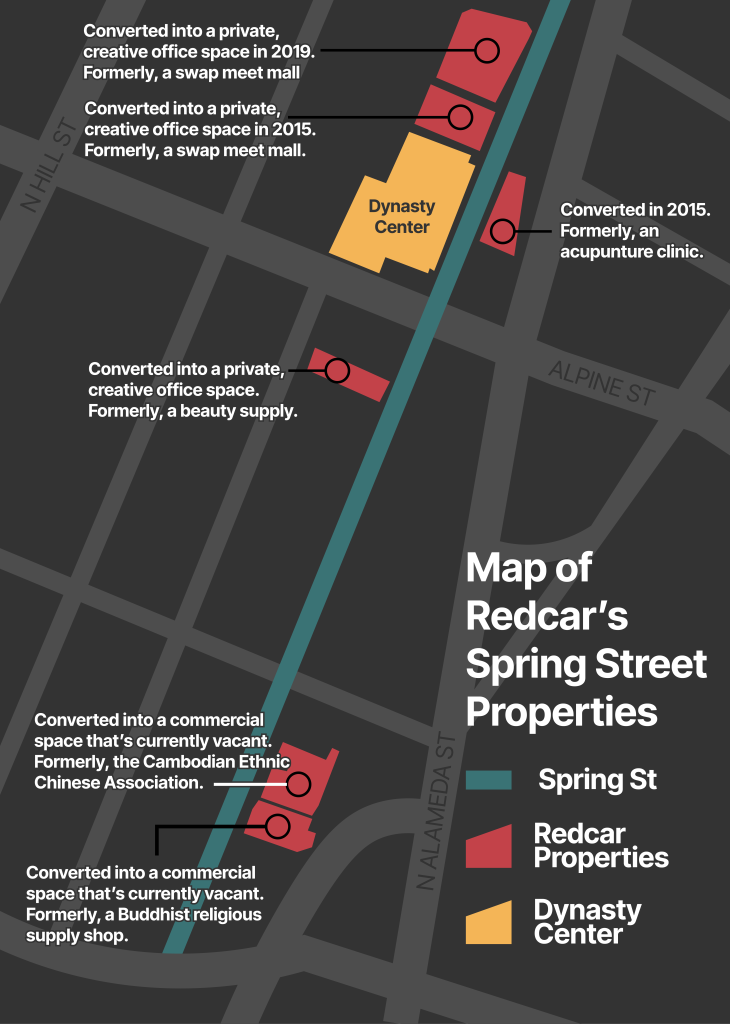
Chinatown Swap Meet Redevelopment Project


The Shop Redevelopment Project


Chen, who is also a recent graduate from USC’s Urban Planning Masters program believes that these new developments take away cultural value from the neighborhood.
“It seems like they don’t want something traditional or they don’t want something that can continue the cultural sense of Chinatown,” said Chen. “It seems like it can be a project in Santa Monica or it can be a project in Silver Lake. Their projects just don’t respond to the social context, the cultural context in Chinatown.”
According to Redcar’s website, they “acquire underperforming properties in high growth urban neighborhoods and add value through specialized redevelopment and deep repositioning.” Despite this, these concrete and glass office spaces have done little to add value for the residents of Chinatown.
I contacted Redcar Ltd. for a comment but did not receive a response.
Of course, Chinatown isn’t the sole enclave of Chinese culture in Los Angeles. By the 1960s, Asian Americans in Los Angeles gained residential mobility, allowing middle-class Chinese Americans to relocate to suburbs nearby suburbs. The San Gabriel Valley, east of Los Angeles, became a favored destination for Chinese Americans seeking new opportunities.
Nevertheless, Chinatown endures as the vibrant commercial and cultural epicenter of Los Angeles’s working-class Chinese American community. Mai Tu lives in the San Gabriel Valley but still chooses to operate her business in Chinatown.
“[The San Gabriel Valley] is very spread out, the cities are so small there,” said Tu. “So at the end of the day, this is the best place to be. Because if you’re coming from out of state, a different country, or just any other place, you’ll come to Chinatown to understand Chinese culture or what there is to buy.”
The 1970s saw a boom in the residential population and shifted to include older, Cantonese-speaking Chinese people and a substantial increase of working-class Vietnamese, Thai, Indonesian, and Filipino immigrants of Chinese descent. By the 1980s, nearly half of the businesses in Chinatown were owned by Vietnamese Chinese like Tu.
Dynasty Center is the last of its kind.


The Fight
Dynasty Center vendors have nowhere else to go if they are evicted.
“We’re just taking it day by day,” said Tran. “Every space has been taken. This is the only place that is available, so we honestly don’t know where we’re going.”
Protecting Dynasty Center’s shopkeepers has quickly become a primary goal for the Chinatown Community for Equitable Development’s (CCED) small business team. They don’t want to see another “creative office space” in the location.
Rather, they want to see the businesses, spaces and most importantly, people who make Chinatown the vibrant community that it is stay in the neighborhood.
CCED has been mending the fabric of the community for over a decade. Since 2012, the organization has worked with Chinatown residents and small businesses to advocate for affordable housing, better recreational spaces, and quality education for the neighborhood.
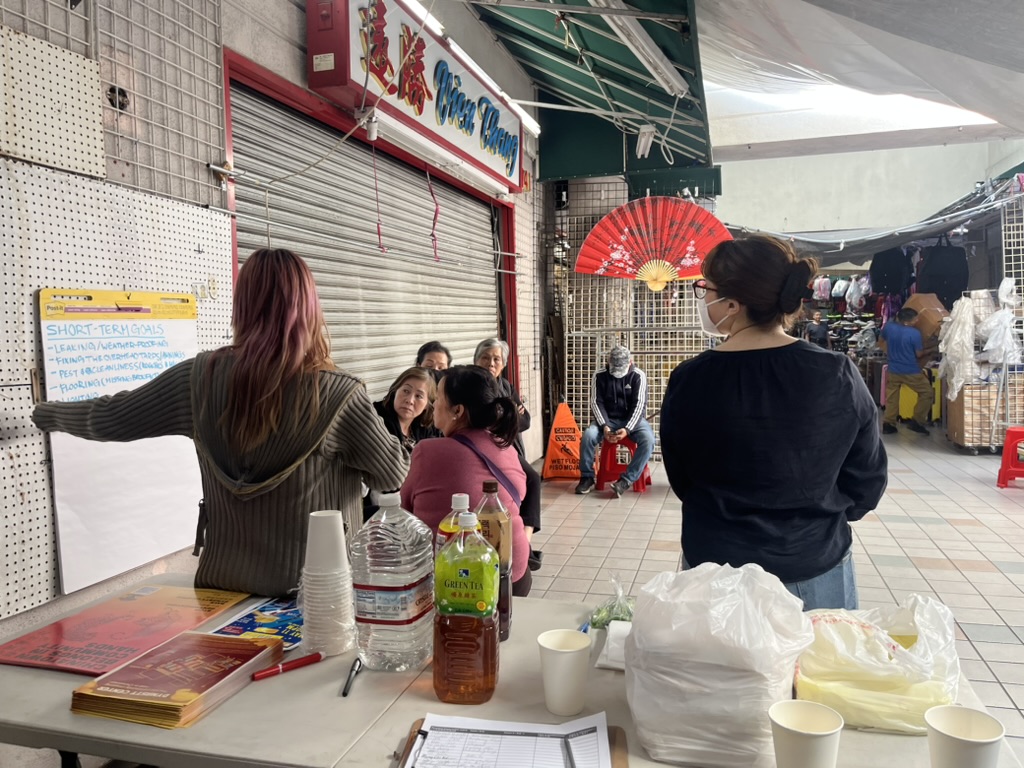
While this organization has been working with the community for over a decade, gaining the trust of Dynasty Center vendors has proved to be the most important part of the fight.
Many vendors were reluctant to push back against the fate of Dynasty Center — not because they didn’t care but out of fear of retaliation from Redcar. Some have cited their ignored pleas to repair leaky ceilings or worries about increased rent. However, what they fear most is receiving an eviction notice at the end of the month.
“They’re scared because their English is not good. They’re unaware of things. They think that by [CCED] helping them out, they might get in trouble with the owner. And the owner knows that,” said Tran.
Not knowing English, not knowing their rights as commercial vendors, and not wanting to lose their livelihood — these vendors feel powerless against the Goliath that is Redcar.
CCED focuses heavily on outreach. Each month, volunteers gather at the community mall to connect with vendors, assess their current needs as small businesses, and provide as much education about how to protect themselves from Redcar.
Raymond Fang is an attorney at the Legal Aid Foundation in Los Angeles (LAFLA) who has been working closely with CCED on the Dynasty Center campaign. In March 2024, he led a “Know Your Rights” workshop at the shopping center to dispel misconceptions when it comes to their leases.
Many vendors at Dynasty Center are on oral, month-to-month leases. This means there is no official paperwork for vendors to negotiate their rights. Rather, their leases are effectively renewed each month when they pay their rent, allowing for surprise rent increases and eviction notices at the end of each month.
This is unusual for commercial tenants — typically, commercial tenants are on 5-year, 10-year, or 20-year written leases that can be dozens to hundreds of pages depending on the complexity of the lease. This abnormality has left vendors uneasy about their safety from being evicted.
“There’s a lot of misinformation out there,” says Fang. “A lot of the vendors there thought they didn’t have leases, or that they didn’t have any rights because they didn’t have leases, and that Redcar could just come and kick them out at the moment’s notice.”
While there are laws that protect tenants, these primarily apply to residential tenants. There is an understanding that there’s a power dynamic between landlord and residential tenant that warrants greater protections for the tenant. Laws surrounding commercial tenancy, however, view the landlord-tenant relationship as an even power dynamic, similar to a business transaction.
This may be true for big, national retailers — Macy’s, Target, Whole Foods, etc. But when it comes to small business owners like the vendors at Dynasty Center, Fang says tenant protections should be negotiated into their lease agreements.
In addition to the know-your-rights training that Fang hosts with CCED, he also works towards bridging this gap in protections.
“Some of the work I do involves state legislative work to put in more protections for small businesses, and then also in the direct services level,” said Fang. “And trying to negotiate better terms for vendors, not just for Dynasty Center, but ideally throughout Chinatown for the small businesses that really need that support.”
Dynasty Center’s uncertain future underscores a larger issue reverberating throughout L.A.’s Chinatown: the plight of its displaced small business owners.
Chen , who is currently earning her Master’s Degree in Urban Planning, believes that “A place like Dynasty Center could an be used as an example of better development policies.”
Mai Tu’s resilience is a testament to her unwavering determination in the face of constant upheaval — from Escaping the Cultural Revolution in China, the conflict in Vietnam, a perilous boat journey to Norway, an eventual arrival in the United States, and dozens of moves around the neighborhood that was supposed to be a safe haven for her in LA
She’s fortunate. While Mai Tu has found a new spot to relocate her business to, she isn’t giving up on Chinatown.
My only wish is for preservation — to preserve at least one shopping center for us. At least one shopping center that sells Chinese cultural items or Chinese food. In all of Chinatown, just one.
Mai Tu, Former Business Owner in Dynasty Center