Bill Cosby survivor and others warn American women of a dystopian future they believe is set to become a reality under Trump’s administration
P
Bill Cosby survivor and others warn American women of a dystopian future they believe is set to become a reality under Trump’s administration
The United States has long stood as a so-called paragon of freedom on the international stage, especially in regards to women’s rights, granting both women and men equal rights and privileges. However, in the past decade, women’s rights in the country have begun to deteriorate, in large part due to President Donald Trump’s growing influence in American politics.
Now that Trump has stepped into office as President of the United States a little over two months ago, many American women, by citizenship or residency, of all ages, ethnicities and creeds, are “terrified” of what will become of their access to proper healthcare, safety in intimate or sexual relationships, romantic partnerships and independence.
“That is what Trump in the White House right now is meaning to me,” said author, activist and Bill Cosby survivor Victoria Valentino. “We’re going to be thrust back into the Dark Ages, where we’re going to have to struggle for every moment of peace, every opportunity that is being ripped away from us, every freedom, every right that we’ve taken for granted.”
“We’re going to be thrust back into the Dark Ages, where we’re going to have to struggle for every moment of peace, every opportunity that is being ripped away from us, every freedom, every right that we’ve taken for granted.”
~ Victoria Valentino
In an interview with CBS News, Trump took credit for the reversal of Roe v. Wade and the delegation of abortion access from the federal level to the states, and has done so in other media appearances, including in a Truth Social post.
Trump justified his stance by stating that he was simply fulfilling the people’s will to have individual states determine access. However, surveys conducted by the Pew Research Center revealed that a majority of the American public has consistently declared support for protection of abortion rights on the national level.
“A second term for us is even more dangerous as we look at just in what he’s been in office less than a month in,” said Emiliana Guereca, Founder of the Women’s March Foundation in Los Angeles. “His first term was devastating for women. Women lost reproductive rights; over 20 states have really restrictive abortion bans.”
While Trump has evaded probes into his own personal beliefs on abortion and other issues affecting women’s rights and freedoms, his stance has been implied by statements made in the first presidential debate of 2024 and through the individuals he chose to appoint during his first presidential term.
Trump’s former vice president, Mike Pence, supported a federal abortion ban after 15 weeks. Trump also appointed three conservative justices to the Supreme Court, who were instrumental in securing the reversal of Roe v. Wade.
Trump has made several new appointments to his presidential cabinet, one most notably being RFK Jr. as Secretary of Health. RFK Jr. has taken a hard stance against medical vaccinations, encouraging people to boycott them. His anti-vax agenda has led to two deaths and hundreds of infections by the measles disease, as parents were influenced against vaccinating their children.
RFK Jr. has now released a statement claiming that vaccinations are the most effective defense against measles.
“We also see the danger in [Trump] putting RFK Jr. in the health department, someone that is an anti-vaxxer, but also someone that has signaled that he would make sure to put more restrictions on the abortion pill,” said Guereca.
Regardless of his appointments, Trump continues to deny his support for a national abortion ban, contrary to many others’ beliefs that he is preparing to sign a ban into effect shortly.
“The United States is regressing. Mexico has a female president, Mexico has enshrined reproductive rights abortion, and so has Argentina, so has Chile. What are we doing?” asked Guereca.
The vulnerability of immigrant women in America
Shortly after stepping into office, Trump signed executive orders ending diversity, equity, and inclusion initiatives. As part of these orders, federal programs were dismantled and companies and organizations, including universities, across the United States were forced to shut down their DEI departments.
“Women’s health is at stake, women’s lives are at stake. The path forward in terms of being in political power is at stake with the dismantling of DEI,” said Guereca.
“DEI what it means, really, is less hiring of women,” said Guereca. “It’s a thin, veiled thing that people think, oh, well, it’s DEI it’s based on race; it’s also based on sex, it is also for women, and it’s particularly dangerous for women.”
This attack on diversity hiring by the Trump administration will have a profound effect on job accessibility for and employment rates of women.
“We’re going to lack representation, yet again, within the White House. When affirmative action passed in the 80s, historically, and what the facts are was that it enabled organizations to hire more women, to bring in more women to the workforce,” said Guereca.
Trump has also pursued an aggressive mass deportation campaign, stating that “on day one, I will launch the largest deportation program of criminals in the history of America,” according to NPR.
Trump officials have since increased arrest quotas for U.S. Immigration and Customs Enforcement officials. There have been ICE raids and sweeps in communities of color and unjust arrests of U.S. citizens or legal green card holders. Most controversial are the deportations of people with legal immigration status and no criminal record from the U.S. to the infamous El Salvador CECOT mega-prison.
“It makes you a target right away, especially with all the immigration policies and the executive orders that are being taken right now regarding deportation, sanctuary cities. We already don’t trust the police, but it makes you avoid them even more,” Eva Burns, community organizer for the Black Alliance for Just Immigration.
As a woman who exists under other intersectional identities, Burns feels even more frightened.
“People like me that are immigrants that are Black and women, folks that are undocumented, they’re trying to stay as low key as possible, so they don’t attract any attention,” said Burns.
She has a friend who is afraid to drive because her license has a note that says “federal limits apply” which immediately signals to the police that she’s not a citizen. It makes her life harder, because it restricts her everyday activities.
“This president is trying to create fear in Black communities and in immigrant communities,” said Burns.
“It’s a lot of uncertainty and fear, because that’s what the current administration has been. Especially as an immigrant, it makes you worry about surveillance, policing, racial profiling; you have to be prepared under any circumstances, because you never know what may happen,” said Burns.
Burns added that living in this constant state of fear creates a mental weight that people don’t see, but that affect Black and immigrant women, which causes depression and leads or pushes people to suicide.
“Let’s be clear all of these issues and all of these agendas. It’s a war on women, and we have known from the beginning. We’re now in a decade – he ran his first campaign in 2015 — in 2025, [it’s been] a decade of the war on women from the Trump regime, the Trump administration,” said Guereca.
CLICK HERE TO BE DIRECTED TO RESOURCES PROVIDED BY THE IMMIGRATION ADVOCATES NETWORK
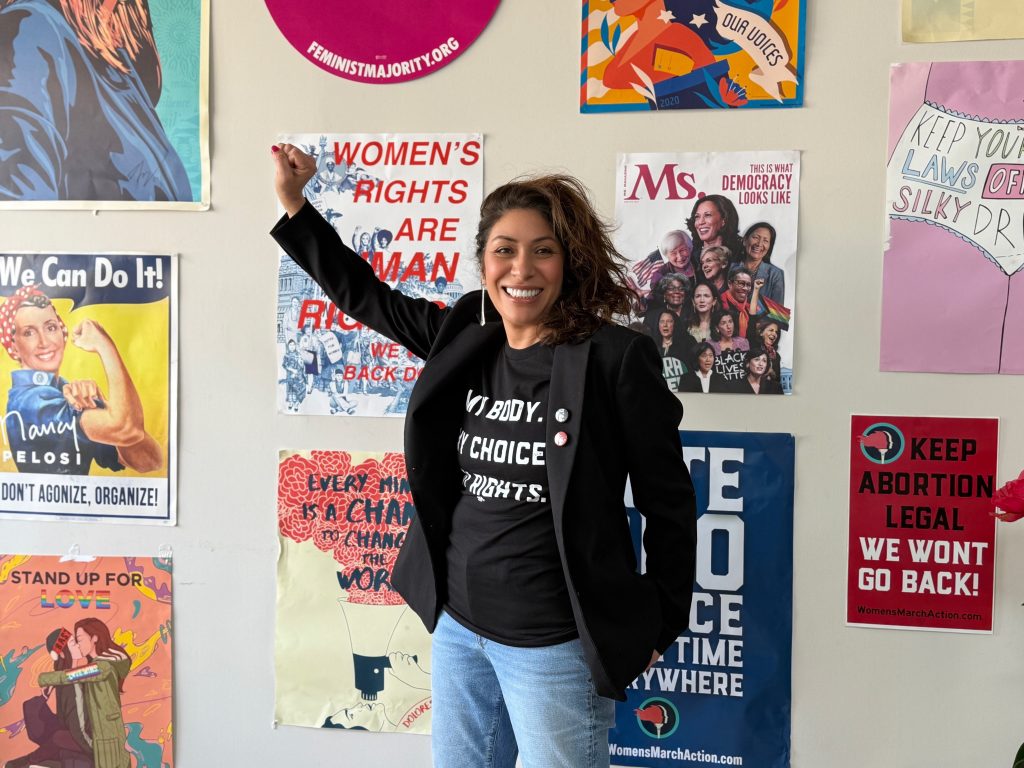
Emiliana Guereca standing in the Women’s March Foundation’s Boyle Heights office holding up a raised fist in a show of resistance and solidarity (Sarah Arencibia/Annenberg Media).
Threatened access to healthcare
“I do think that women are living in fear, truly. I mean, we have some states that are looking at reporting women that have had abortions. Bounty Hunters in Texas in particular, is one of them. Missouri is another one,” said Guereca.
Valentino warns the women of America, especially younger women, about the realities of living in a country where necessary and life-saving healthcare is inaccessible, as she lived through a time when this was her reality.
“I think all women need to be watching their backs, I think we all have reason to fear,” said Valentino.
“The younger generations have become so complacent, because of all of the rights we fought and got bloodied to attain for you all, you’re so used to them, you don’t understand what it was like when we didn’t have them. And it was rough, baby, it was rough,” said Valentino.
Valentino received an illegal abortion in 1962, eleven years before Roe v. Wade was originally passed in 1973 and the right to abortion was legally protected. Per her opinion, her experience was nothing short of dystopian. Prior to the abortion, “I was raped by the medical doctor who performed it after he drugged me and made me immobile,” said Valentino.
As a former registered nurse, Valentino had also witnessed pregnant women in medically dire situations put their lives at risk in fear of legal repercussions that came with having an abortion or receiving other types of medical intervention.
“I have seen girls lying on sofas with ice packs on their lower belly, with their feet up, bleeding out, looking gray and blue-lipped, and terrified to seek any kind of medical help, and undoubtedly dying in the end, either by infection or through exsanguination,” Valentino said.
Control over women’s bodies has long been exercised by the American government as an avenue of controlling women, according to the Brennan Center for Justice. In the 1700s, when common law first originated in the United States, rape was considered a property crime committed against the survivor’s father.
“The ability to control one’s body is intrinsic to controlling one’s life. This is true along the entire reproductive continuum, from sex to abortion to delivery,” a report from the Brennan Center said.
Even though it also takes a man to conceive a child, there are no laws holding them responsible for or limiting their freedom in relation to conception, according to the Brennan Center. Only women are held liable for conception and subsequent child rearing.
“The old white guys in power [say] it’s about morality, but it makes my head want to explode, because they don’t give a damn about morality; it’s all about power and control,” Valentino said. “They don’t have the capacity to control women because of our intellect, our academic achievements, our professional achievements, so how else can they control us? Through our biology.”
It is clear the motive behind banning abortion is not simply to protect the lives of fetuses, but to have control over the trajectory of American women’s lives, according to an article from the award-winning online magazine Political Violence at a Glance written by Emily Hencken Ritter. According to Ritter, abortion bans are a form of political repression and are considered discrimination under international human rights laws.
These bans directly violate rights of women and girls afforded to them by the United Nations Universal Declaration of Human Rights, including: the right to life; the right to the highest attainable standard of physical and mental health; the right to benefit from scientific progress and its realization; the right to decide freely and responsibly on the number, spacing and timing of children; and the right to be free from torture, cruel, inhuman and degrading treatment and punishment.
“The decision [to ban abortions] inherently disproportionately affects women and girls. An estimated 73 million induced abortions take place globally each year. Approximately 45 percent occur unsafely, primarily in developing countries. Unsafe abortion is a leading—and entirely preventable—cause of maternal deaths and morbidities worldwide,” Ritter said.
Studies have shown that Black women are more likely to die while giving birth than any other race.
“As a Black woman, I’ll be safer giving birth in a different country than giving birth in the US,” said Burns.
Burns said that her pain level isn’t aways believed, because there are unhealthy stereotypes out there about Black individuals having high pain tolerance, negative stereotypes that are pushed by certain Republicans and Trump himself.
“We’ve heard him circulate negative stereotypes about Black folks and that’s a narrative that he’s building, and that’s going to stay in people’s mind, and that will eventually affect the different services that we get, including in the healthcare system,” said Burns.
Women in the United States experience the highest maternal mortality in comparison to women from all other industrialized democracies, according to the UN Women’s Database.
Burns also mentioned that there’s a lack of inclusivity in language access at hospitals and other healthcare facilities. Most language translations available are for Spanish, French, or Chinese, but there aren’t any translations for Afro-immigrant languages. Burns thinks that Trump’s new DEI policies and stance on diversity will make it even harder for this language access to improve.
When men in the American government take away a woman’s bodily autonomy and ability to determine when and with whom she has a child, they are affecting her ability to receive higher education or economic advancement, as well as control over her social and political experiences, according to the American Association of University Women.
“Women remain more likely than men to take time away from the workforce or to reduce their work hours because of caregiving responsibilities. According to the Institute for Women’s Policy research, 43% of women workers had at least one year with no earnings, nearly twice the rate of men,” according to the American Association of University Women. Mothers are also less likely to be hired by employers than single women and men.
Guereca believes that Trump’s executive orders and presidential cabinet appointments are going to affect the citizens of the US, and particularly women, for decades to come.
“There are women that can no longer afford reproductive care because they have to travel out of the state, which means that women will be tasked with having more children. Women will be tasked with possibly not having enough education, as they’re taking care of their children. And maybe if they hit the workforce, the DEI is not there and they’re not going to get hired. This will continuously affect us,” said Guereca.
Women’s Rights Poster Wall
Emiliana Guereca, founder of the Women’s March LA, walks us through posters created by local LA artists and activists hanging on the wall of her organization’s Boyle Heights office
The complicated relationship between trans women and civil and women’s rights movements
Often forgotten are trans women. Members of the general public and certain activist organizers alike have a difficult time categorizing trans women’s rights as falling under women’s rights.
“A lot of queer and trans affairs, traditionally, don’t get looped into abortion justice work, but there are queer and trans people in abortion justice work,” said Camila Camaleon, policy director at California Latinas for Reproductive Justice and president of the San Gabriel Valley LGBTQ Center.
Camaleon believes that abortion justice work is a queer and trans movement, just as much as it is a women’s rights movement.
“That’s why the reproductive justice movement has the existence that it currently does, because queer and trans people are resilient, because we imagine innovative ways of engaging the policy and different types of structures,” said Camaleon.
Guereca believes this exclusionary culture found with women’s rights circles is furthered by Trump’s divisive narratives.
“His agenda has always been about othering everyone, and whether he is attacking women, trans women, people of color, his always, his tactics are always about othering,” said Guereca.
Many states across the country are no longer providing trans care, according to Guereca.
“As soon as Roe fell, clinics across the country stopped providing. The providers are gone,” said Guereca.
During her transition, before even the first Trump administration, Camaleon was told that insurance would not cover the laser hair removal for her legs, a body part that can cause gender dysphoria for trans people. She had to submit claim after claim because this issue wasn’t documented or classified as a specific issue.
“Why are cis people determining the level of severity of dysphoria for trans people? That’s the end all be all and we really need to talk about that, because the reality is that we’re not really creating space for them,” said Camaleon.
Now she’s worried these obstacles could become even more prevalent for trans women trying to access these types of healthcare services.
“What’s under attack is the imagination of queer and trans people’s lives and visibility. It’s not just our day to day livelihood or access to gender affirming care and access to our own bodily autonomy and how to have families. It’s really a matter of attacking the human spirit,” said Camaleon.
The safety that Camaleon feels as a trans woman in the US has always been in transition, and she’s had to grapple with it in different ways. In the current political landscape, she said it’s difficult to feel safe.
“For myself as a trans woman, it’s a very scary time,” said Camaleon. “I think that not everybody feels safe; feeling safe shouldn’t feel like a luxury, it should feel like something we should all have access to.”
According to Camaleon, Laverne Cox on the cover of Times Magazine for the first time is considered the “trans tipping point”, the point in time where trans people, and especially trans women, began to see representation and receive acceptance in American society.
Before 2016, however, when that magazine issue was published, there had been perpetual violence against Black trans women for many years, according to Camaleon.
“On Trans Day visibility, there are lists that go out of all of the folks that have been impacted by violence enacted by people all across the world,” Camaleon said.
Nowadays, under Trump’s administration, Camaleon said there seems to be a lack of awareness of who trans people are, often leading to bullying and shaming of trans people, as well as restriction of access to basic necessities, like restrooms.
Camaleon referenced Republican Rep. Nancy Mace’s push for banning transgender women from using female restrooms in federal buildings in November 2024, which came only weeks after Sarah McBride became Congress’ first openly transgender member.
“What does it mean when we don’t have access to that necessity in buildings and structures that are then eradicating just the way that we exist?” asked Camaleon.
According to Camaleon, within the past two years, Democrats both in the general public and in electoral offices are no longer voting in favor of policies supporting trans rights, support that had previously been garnered. She believes these Democrats are being influenced by the Trump administration’s dominant anti-trans narrative.
“Trans people are always a concession, specifically when we think about where people can make a cut so that policies can be made, trans people will always be cut,” said Camaleon.
The recent rise of misogyny
With misogyny on the rise in the U.S., trans activists worry about the effect the ideology will have on American politics.
“Trans people have been mourning the rise of misogyny for many years,” said Camaleon.
Male politicians have made misogynistic policies a larger part of their political platforms, making America a breeding ground for hyper- and toxic masculinity.
According to Damaris Ortega, president of the Pad Project’s USC chapter, Trump is encouraging hypermasculine, machismo culture in American society, influencing many young men to adopt misogynistic ideologies. She adds that young men see Trump as a role model for masculinity despite the mass amounts of misinformation he posts about women’s bodies and capabilities.
Leading up to and following Trump’s victory in this year’s presidential election, American women have experienced “an onslaught of online abuse and harassment,” according to the Institute for Strategic Dialogue (ISD).
Since mid October of 2024, there has been a significant increase in content calling on the government to repeal the 19th Amendment of the US Constitution, which afforded women the right to vote. On election day and well after, there was a spike of posts mentioning the trending phrases ‘your body, my choice’ and ‘get back to the kitchen.’
One TikTok creator had to take down a video she had posted because the comment section was flooded with comments by male users saying they could not wait until she got raped.
Young women and girls have even experienced this harassment offline, with boys directing these misogynistic phrases at women, even sometimes chanting them in schools.
Misogynistic public opinion has been thriving since Trump’s election.
“We’ve been permissive. I think he has really put out there that you have to be a supposed strong male and be a sexist male,” Guereca said.
Ortega said widespread misogyny is very common in Latino households. Coming from one herself, she grew up with a father who believed women shouldn’t be running for these high-ranking political positions.
Many Latino men voted for Trump in this election and support his more regressive policies regarding women’s rights, but this sexism isn’t relegated to Latino communities. Evidenced by research studies, Americans of all demographics weren’t ready for a female president.
A study conducted by The Survey Center on American Life regarding the importance of having a female president found this matters a lot less to men in America than it does to women. Only 35% of American men maintained that having a female president was important as opposed to 49% percent of women.
Interestingly enough, however, a Pew Research Center study conducted in 2023 surveyed men and women from both Democrat and Republican parties if a woman would make a better president than a man based upon five distinct categories: working well under pressure, working out compromises, standing up for what they believe in despite political pressure, being honest and ethical and maintaining a respectful tone in politics. Almost everyone surveyed, regardless of gender or party, felt that either gender had no effect on these leadership traits or that a woman president would be better than a man.
This discrepancy in public opinion is a testament to the gender gap in how women are perceived and represented that has existed for decades and still exists today.
According to Ortega, women can never make everyone happy. Society always has an opinion about women and their leadership abilities; if they are too assertive, they are called bossy, but if they aren’t, they’re considered too soft and lenient. Men in leadership positions, on the other hand, are instantly respected and regarded as fit for the job.
“If you’re a woman and you’re a boss and you’re very strict then you’re going to be seen as bitchy,” said Ortega. “But if it’s a man, you just see him as this powerful person that you got to respect.”
Ortega recalls seeing jokes being made at former Vice President Kamala Harris’ expense, with many conservative voters calling her Camel Toe, a derogatory nickname which attacks her gender and thus insinuates that being a woman undermines her presumed fitness for the presidency.
“The idea that equality and being equal is their issue, it just means we have more work to do in society in terms of what equality looks like. It doesn’t mean more rights for women and less rights for men. People think that feminism means we’re man haters. We’re not man haters; we want equal rights,” said Guereca.
“We have to stop and look at the fact that, over the years, [during] all the wars that have been [fought], all the men were gone,” Valentino said. “Who was keeping the foundation of society together, raising the children, paying the bills, getting out there and supporting the men who were on the other side of the world blowing up other people’s family homes? So who’s strong?”
Valentino grew up in a household where her father refused to allow her mother to learn how to drive, so her mother had to enlist the help of a local taxi driver. Once Valentino’s mother was able to drive and she got a job at a nearby boutique, Valentino’s father had her fired. He told her manager she couldn’t work at the boutique anymore because he needed her at home.
“When you grow up with that patriarchal climate, that environment, it’s hard to break through it, but when you do, you don’t want to go back,” she said.
Valentino said she doesn’t want to see women treated like they were when she was growing up. When she was raped, her surrounding peers, and even her family, put the blame on her. The established rhetoric at the time, during the 1940s and 1950s, was that for a woman to be raped, she must have been hypersexual, someone who just got around. The term slut was often used to identify rape survivors.
But she is worried that because of who is sitting in the presidential office, American society may very well be transported back to the 1950s.
Chimamanda Ngozi Adichie speaks at a TED Talk on the importance of feminism in her Nigerian culture, one diametrically opposed to feminist ideology. Her anecdotes serve as a case study for the necessity of the feminist movement’s worldwide proliferation. An excerpt from her speech was sampled in Beyoncé’s song Flawless, released on her Beyoncé album in 2013.
The portion of Beyonce’s Flawless lyrics featuring Adichie’s speech excerpt: We teach girls to shrink themselves, to make themselves smaller We say to girls: “You can have ambition, but not too much You should aim to be successful, but not too successful Otherwise, you will threaten the man” Because I am female, I am expected to aspire to marriage I am expected to make my life choices always keeping in mind that marriage is the most important (C-Candy on the ground) Now, marriage can be a source of joy and love and mutual support (Dum-da-dee-da) But why do we teach girls to aspire to marriage and we don’t teach boys the same? (Do-da-da, do-do, do-do-do-da) We raise girls to see each other as competitors Not for jobs or for accomplishments, which I think can be a good thing (Com-com-comin’ down, drippin’ candy on the ground) But for the attention of men We teach girls that they cannot be sexual beings in the way that boys are (Dum-da-de-da) Feminist: A person who believes in the social, political, and economic equality of the sexes (Do-da-da, do-do, do-do-do-da)
The aftermath of abuse and sexual assault
Trump has been found liable for sexual abuse. He has over 20 sexual misconduct allegations against him and consistently showcases extreme misogyny.
Over 71 million Americans voted for a man widely recognized as a sexual abuser into the presidential office. His election into office is America’s way of giving him a free pass on being held accountable for his actions, according to Ortega.
Ortega also believes Trump’s presence in the US Presidential office could encourage men to participate more in inappropriate behavior towards women. Many young men will feel less deterred in committing acts of sexual violence or rape, presumably thinking, ‘He did it, why can’t I?’
The existence of rape culture has been routinely denied, yet it exists and is pervasive in American society. Unfortunately, many women who survive rape do not report it to the police or seek medical treatment, fearing how their testimonies will be received.
“Only 18% of the adult women’s rapes and only 11% of the assaults of children were reported,” according to a study done by the National Institute of Health (NIH).
A survey conducted by the NIH found that women are often dismissed or blamed when they speak up about having been raped.
When they confided in family, friends, or even professionals and formal support providers, their experiences were often questioned, leading them to shame and silence themselves. Some women were even pushed into considering if their experiences qualified as rape at all, according to the NIH survey results.
“Unlike other crimes such as burglary and assault, rape survivors must prove not only that the crime did in fact occur, but that they had no role in its occurrence,” according to the NIH. “But, for most survivors, no matter what they did or how they behave, they are likely to be blamed for the assault.”
Rapists end up flying under the radar because these legal, medical, familial and religious support systems in place fail the survivors. Even when they are found liable for their crimes against women, as Trump was, there seems to be little to no consequences for their actions. Trump’s victory in the 2024 Presidential Election is a testament to this grim reality.
“We’ve had conversations where people think that the #MeToo Movement went too far. What is too far?” asked Guereca. “We decided we didn’t want to be assaulted at work. We decided that we want to be treated fairly and equally. That is not too much to ask.”
“Women’s rights should have never been politicized. They should not belong to a party,” said Guereca.
Guereca believes that there needs to be policies set forth where women’s rights are at the forefront and establish women as equal to men. According to her, no matter a woman’s race, socioeconomic level, or education level, in this political climate, she is not treated as equal.
Guereca believes that the American public ended up voting Trump into office due to these sexist and racist ideologies pervasive in American society and politics.
“I’m horrified, I’m sick to my stomach just looking at [Trump], and hearing his voice triggers all of my predator warnings in the pit of my stomach and my solar plexus,” Valentino said.
While studying to become a registered nurse at Glendale College, working, and living and taking care of her two daughters, in a one bedroom apartment, Valentino was abused by her children’s father, who was a known alcoholic. He would consistently get angry and violent, often accusing her of having an affair because she was out all night in her microbiology classes.
She stayed with her abuser because she needed help taking care of their kids, desiring the touted nuclear family. Valentino said women, herself included, often stay in abusive situations because they are afraid of the unknown, and they do not have the faith or confidence in themselves to brave it. “We put up with a lot because, it’s sort of the devil you know versus the devil you don’t know,” Valentino said.
The American government and legal system has put women in these positions of helplessness by not writing their rights into the Constitution. It was not until decades after the United States was established that women earned the right to vote and right to own property, because for a long time they were considered property themselves.
It wasn’t until 1974, when Congress passed the Equal Credit Opportunity Act, which banned discrimination within financial borrowing transactions based on gender or marital status, that women were allowed to open up their own lines of credit, according to the US National Archives. Before then, a woman’s credit was assessed alongside their husband’s or father’s, and a man’s signature was required to solidify any borrowing transaction.
A lack of financial freedom is one of the main reasons a lot of women end up stuck in abusive partnerships and marriages, according to an article published in the William & Mary Journal of Race, Gender, and Social Justice written by Dana Harrington Conner.
“It is clear that [abusers] are able to maintain control over their victims due, in large part, to the economic insecurity of women who are abused,” Conner said. “Economic dependence is the link that binds a woman to her abuser, drawing her in over and over again; it is, in effect, one of the best predictors of continuing violence once the abuse begins.”
Financial insecurity also increases the chances of a survivor of intimate partner violence returning to their abuser.
It was not until after Valentino received her Associate of Science degree in allied health and secured a job as a registered nurse was she able to support herself and her children without having to resort to relying on abusive men for childcare and financial assistance.
While Valentino was able to physically shed these men from her life, she was left with a life-long mental disorder: post traumatic stress disorder. In her younger years, she was also suicidal.
Survivors of sexual violence often experience consistently heightened feelings of stress, anxiety, and fear that cause them to feel as though they are in a constant state of danger, making it difficult to function in everyday life, a condition known as post traumatic stress disorder, according to Rape, Abuse, and Incest National Network (RAINN).
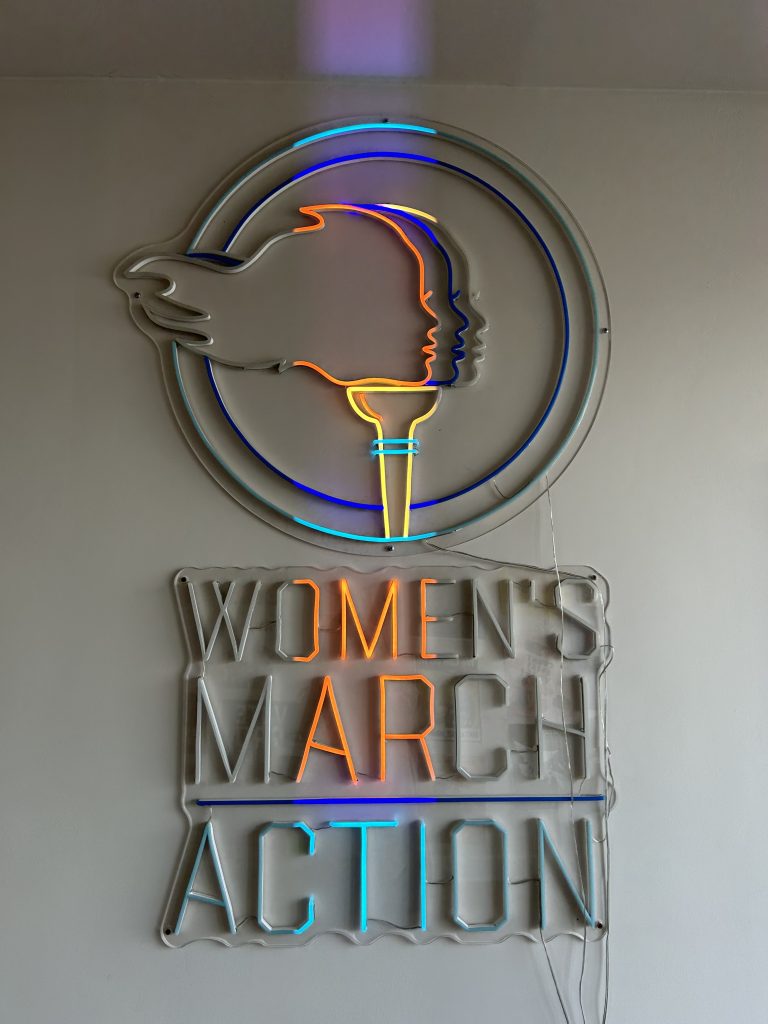
Neon sign displayed at the Women’s March Foundation’s Boyle Heights office (Sarah Arencibia/Annenberg Media).
The collective strength of women
Women have stood as the backbone of the American household, and by proxy, the American society, yet they are treated as though their contributions do not matter, as if they do not matter. As a result, their mental, physical, emotional health and economic wealth and careers end up suffering.
“We put ourselves aside for society, for children, for the future generations and for the men,” Valentino said. “Then our lives are passing us by, and low and behold, we get to be my age, and we look back on our lives with no guarantee that we’re going to wake up tomorrow morning, and we’re left asking ourselves: Where did my dreams go? Where did my career go? Where did my academic accomplishments get me?”
Despite the gender discrimination and relentless abuse Valentino suffered and has witnessed other women experience throughout her life, she remains strong and hopeful for future generations of women and the future of America.
“I have to have faith in the pioneer spirit of women, because this country is going to be saved by women, women with guts, women with balls of steel and spines of steel, and a narrow focus on survival. So we have to learn how to survive,” Valentino said.
“I have to have faith in the pioneer spirit of women, because this country is going to be saved by women, women with guts, women with balls of steel and spines of steel, and a narrow focus on survival. So we have to learn how to survive.”
~ Victoria Valentino
The women Valentino grew up around inspired her tenacious attitude and grit, especially her grandmother, who raised her two children during World War II. By day she worked at her children’s school’s daycare and went to school for a master’s degree in teaching, and fixed up bomber planes by night.
“Those are the kind of women whose shoulders I stand on, and we have to remember them, we have to honor them, and we have to go back to being them now,” Valentino said. “That’s who we have to be.”