Parachutes for Aircraft
The life saving technology that gets the entire aircraft down to do the ground safely in emergencies
On a crisp November day, Tom Donaldson’s Cirrus SR22 plane climbs 10,000 feet in the sky as he begins his flight from Wisconsin to Ohio. As a private commercial pilot ferrying cargo, the 55-year-old enjoys the blue, clear skies as he approaches the aircraft’s cruising speed of 180 knots.
Then, the engine temperatures suddenly surge.
Drawing on his 15 years of flight experience, Donaldson’s hands move with practiced precision as he switches the boost pump and adjusts the mixture lever in a desperate attempt to fix the issue. Despite his efforts, the engine continues to sputter and lose power, sending a surge of panic through his veins.
“This is how I die,” Donaldson thought.
A Federal Aviation Administration inspector found that the mechanic who conducted the plane’s last maintenance failed to properly secure the air lines, which caused a loss of engine power.
At that moment, Donaldson couldn’t allow fear to take over. He refers to our “lizard brain,” highlighting its role in triggering the fight-or-flight response during threatening situations.
“If you’re in a cockpit by yourself, you freeze, you’re dead,” Donaldson said. “There’s nowhere to fly away to. So you’ve got to fight. Got to fight the lizard brain got to fight the fear.”
With his heart pounding in his chest and his mind racing, Donaldson fights to suppress his instinctual fear and focus on his task. Amidst the chaos, he methodically assessed the feasibility of landing the four-seater aircraft at the nearest airport, knowing that every decision could mean the difference between life and death.
As the ground rushes up to meet him, Donaldson makes the split-second decision to deploy the parachute system as a last resort at 3,500 feet. With a loud pop, the parachute billows out behind the aircraft, slowing its descent as it drifts toward a patchwork of fields below. Finally, with a harsh jolt, the aircraft lands on top of an irrigation system in a sprawling farm field in Sand Creek, Wisconsin, on Nov. 21, 2018, leaving a trail of dust in its wake.
But it wasn’t a parachute for him, it was a parachute for the entire aircraft.
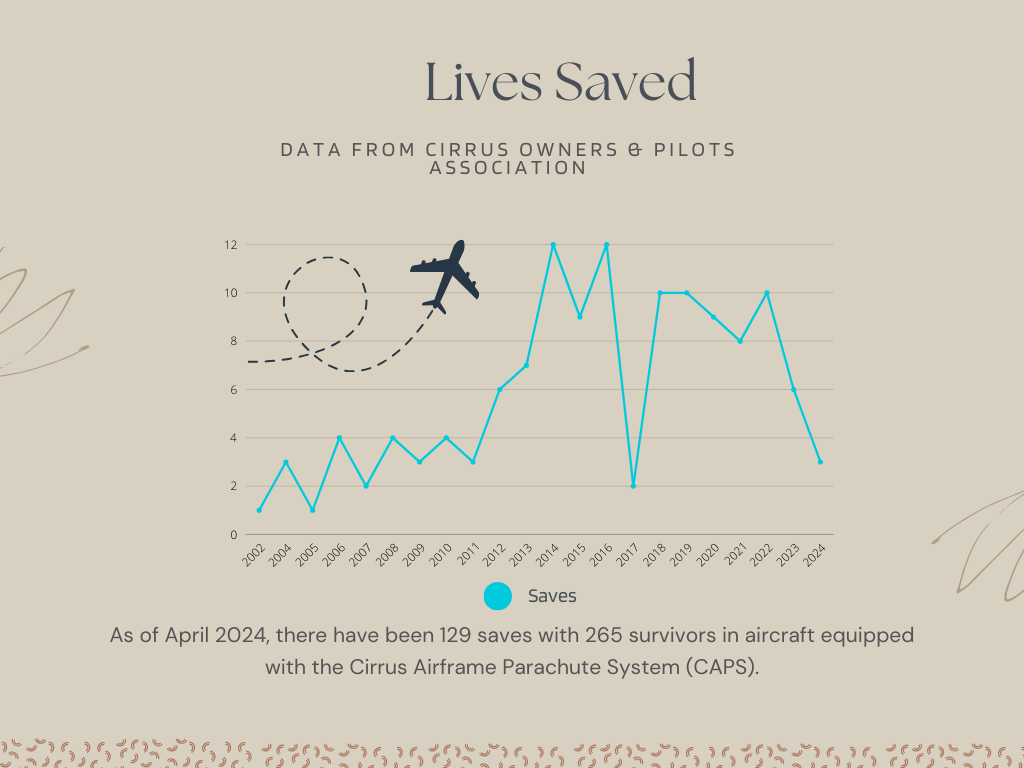
Throughout the world, the Cirrus Airframe Parachute System, or CAPS, has – as of April 2024 – opened 152 times, saving 265 lives. In November of 2018, Donaldson became save No. 81.
According to Cirrus accident statistics, Cirrus planes have been involved in 21 fatal accidents in the past 36 months. Over these three years, they logged roughly 2.7 million flight hours, resulting in a rate of 0.78 fatal accidents per 100,000 flight hours which is lower compared to general aviation’s rate of 0.95 per 100,000 flight hours.
Benjamin Lipson, a professional pilot and flight instructor who works with several types of aircraft, said, “It’s hard to justify flying another aircraft.”
CAPS, introduced in 1998, is a whole-aircraft recovery parachute system. In an emergency, the parachute gets the plane to the ground. It is a final option built into every Cirrus aircraft, including the seven-seater Vision Jet and four-seater SR22T, SR22 and SR20.
For some 20 years, the SR22 series – made in Duluth, Minnesota – has been the world’s best-selling general aviation plane.
CAPS is the brainchild of Cirrus co-founder and engineer, Alan Klapmeier. He created CAPS with his brother, Dale Klapmeier, after surviving a mid-air collision in 1985
The concept behind CAPS is simple.
If for whatever reason – mechanical trouble or pilot error – the parachute expands and brings the plane down.
Lipson, owner of La Verne, California-based Lipson Aviation, calls it a “get-out-of-jail free card.”
Pumped full of adrenaline, Donaldson yanks the activation lever with a 45-pound force igniting the rocket. The memory of that moment is still vivid in his mind – the visceral violence of pulling that red lever, each pound of force extracting the tightly packed parachute from its spot behind the baggage compartment.
After four seconds, the smell of sulfur permeates the air and line cutters beneath the skin of the plane rip out. The slider ring slows the parachute inflation, making sure the nylon doesn’t shred.
The airplane then hurtles towards the earth nose first. Farm fields, power lines and trees fill Donaldson’s vision as he hangs in suspense dangling from his seatbelt.
Next, a series of pyrotechnic line-cutter fuses sever a snub line. That prompts the lines to reach full length and right the plane. Again, Donaldson was shocked by the violence of this process as he was rocked back into his seat as the plane leveled.
Descent speed with the parachute is approximately 1,700 feet per minute. Meaning, the plane hits the ground at an impact equivalent to dropping from 13 feet. With the wind having sole control over the direction of his plane, Donaldson’s SR22 landed on top of a farm’s sprinkler irrigation system about 12 feet in the air.
In January 2015, pilot instructor Lue Morton became save No. 51. Flying a new Cirrus SR22 from California to Maui, the fuel system glitched. He pulled the red lever and settled the plane into the Pacific. He crawled out into the emergency life raft. The plane sank, but he survived unhurt.
Save No. 123 took place in Brazil March 2023. A Cirrus SR22 came down, – reportedly due to engine failure, – at a rice plantation. All four on board, including two children – one just three days old – were found dazed but unharmed.
Tom Donaldson’s parachute billowing in the wind after his crash on Nov. 21, 2018.
Cirrus’ motto: “Pull early, pull often.”
CAPS does not – cannot – guarantee safety. Nothing can.
Most of the 31 known fatalities linked to CAPS pulls happened when the parachute was deployed at low altitudes. One took place at a high-speed deployment – at 270 knots indicated airspeed, or about 311 mph.
“People were dying when they didn’t need to die because they weren’t pulling the chute,” Donaldson said. “A lot of it was social acceptance, it’s like a macho attitude among pilots, ‘fly the aircraft to the scene of the accident, don’t give up.’ So pulling the chute was like giving up or something.”
“Some people,” Mark Volk, a private pilot of 17 years, said, “burned some big old holes in the sides of mountains and into the runways or into dirt in a perfectly good airplane.”
The National Transportation Safety Board, analyzing these accidents, said they were due to training issues. Cirrus then created a video-intensive, type-specific training program called Cirrus Approach that emphasizes deciding in advance when to use the parachute system.
From a peak of 16 fatal accidents in 2011, the number has steadily gone down every subsequent year, despite the fact that more SR20s and SR22s are logging more total hours than ever. In 2014, the number of fatal Cirrus accidents fell to three during a year in which almost 6,000 Cirrus aircraft logged more than 1 million total flight hours.
Some pilots, however, argue CAPS gives pilots a false sense of security, leading to unnecessary risks.
“Woah anything happens, that chute is going to save me. No, it doesn’t,” Captain Ross Aimer, one of the most experienced airline pilots in the world and CEO of Aero Consulting Experts, said. “It’s not a 100 percent thing that no matter what happens it saves the airplane.”
“People are taking their airplanes into situations where they shouldn’t be,” Lipson added. “Into bad weather, into scenarios where maybe they’re not proficient enough to be flying because they know worst case scenario – pull the parachute.”
Volk said flying with the parachute is like having an insurance policy.
“It does give me a certain comfort to fly in areas that I would be a little apprehensive about flying over if I didn’t have the parachute,” he said. “[But] you shouldn’t let it direct you to do more dangerous things because you have this added safety equipment that a lot of people don’t have.”
Others say the system is too heavy, and the added weight makes the aircraft less safe overall.
Weight affects balance, stability, performance and fuel burn.
The parachute system weighs 80 pounds; the parachute itself is 30 of that. However, the plane is designed to accommodate this weight and it is factored into its basic empty weight, Lipson said. In terms of operation, weight is not an issue.
Another factor – cost.
Volk bought his 2004 SR22 secondhand for $200,000 in 2007. A 2023 secondhand Cirrus today goes for $1.175 million. CAPS must also be repacked every 10 years, costing $35,000.
If Volk had all the money back for the 1,500 hours he has spent flying, he could buy the 2022 Cirrus. He is the only flyer in his family and said it’s all worth it.
“It’s a little bit of a time machine,” Volk said.
Plenty of times, he said, he flies to Palm Spring or Santa Monica to grab dinner.
“I like flying [because] I’ve gotten better at not being afraid of different things. It’s very dynamic. I just find it fun.”
“Parachute or not, I think it’s something that he loves to do,” Volk’s daughter, Kristin Steffi, said. “Wherever he may be up in the air, knowing that he has this parachute system on his plane for sure makes me feel safer.”
Mark Volk pulling his SR22 plane out of his hangar at Brackett Field Airport.
Lipson works with seven different types of aircraft. With his second son just ten months old, he said he feels a sense of relief when he is able to fly in a Cirrus.
“It has saved many lives. Many people have been able to go home to dinner with the rest of their family because of it.”
So what’s the future of CAPS? The system is not currently approved for larger commercial planes.
Lipson noted the challenge of implementing the CAPS system in planes bigger than the Cirrus Vision Jet. Moreover, it may not be effective at higher altitudes, where larger planes typically fly.
Captain Aimer, who has flown every Boeing and Douglas ever made, also added the logistics of implementing a parachute capable of holding an almost one-million-pound plane is improbable at this point. Further, the technology on commercial planes today such as the Wind Shear, Autopilot and Traffic Alert System renders a parachute unnecessary.
While CAPS may not be feasible for commercial planes right now, people like Donaldson who fly for private commercial work are thankful for this parachute system.
“Pilots should not have to die either for their mistakes, or a failure of somebody else’s mistakes or because of a bad decision,” Donaldson said. “They shouldn’t have to die. There should be a backup system which the parachute is. That’s what it does and it does it very successfully. I’m grateful for it for sure.”
Andie Kalinowski
Andie Kalinowski is a recent graduate from the University of Southern California with a B.A. in Journalism. Most recently, she interned for the documentary company Backlot Productions in partnership with Boundless Films. Andie has also worked as a TV news producer and investigative reporter. She is passionate about writing and producing impactful content that drives meaningful change.
Contact Andie:
andiekalinowski@alumni.usc.edu
www.linkedin.com/in/andie-kalinowski