LA Stray “Cat”astrophe
By: Suejin Lim
The program set up to control the stray cat population,
and why it is not enough.
Every evening, Chester awaits his friend Tate McCardle outside his apartment, demanding attention and most importantly, food. Other people in the apartment complex have grown used to Chester, and occasionally give him a little snack as well. In fact, because of this abundance of food, he has made friends who also join in on bugging the neighbors.
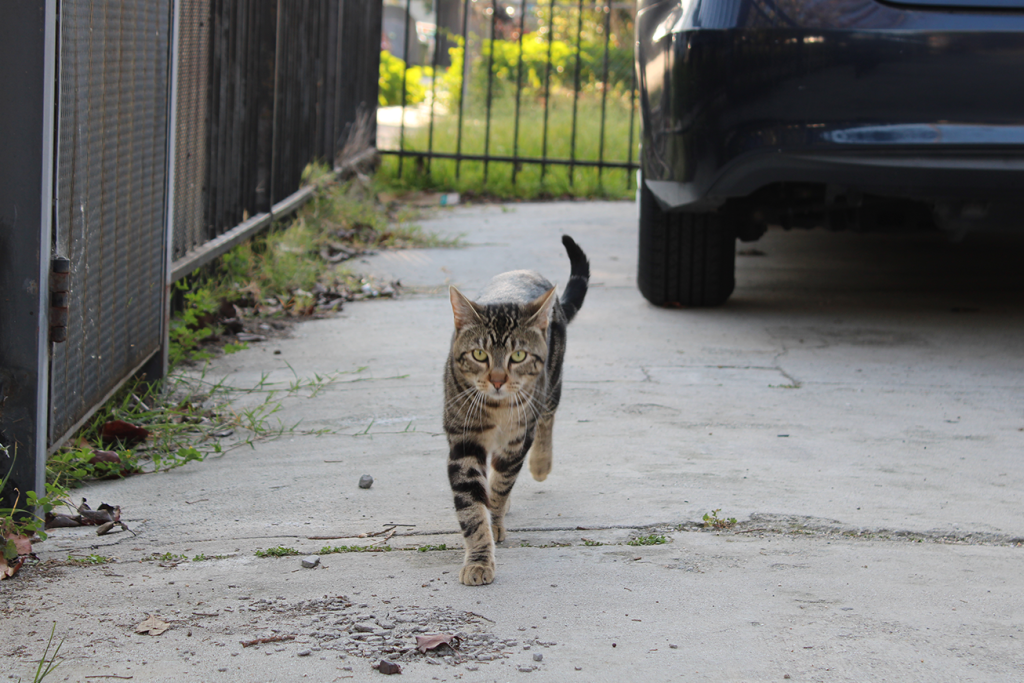
Chester is a community cat.
Although he does not have a specific owner, he is cared for by a local community of people and lives outdoors. Others may call him a stray, and more uninformed people may call him a feral cat, but he is highly socialized and harmless to the humans around him.
Animal shelters and organizations are trying to stay away from the term “stray cat” to promote the term “community cat” which suggests that the cat belongs to a community. Feral cats can also fall under the term “community cat,” but the only difference is that feral cats are not socialized.
Tate McCardle, a student at USC studying for his M.A. in Philosophy and Law, has fed the tabby almost every day since he moved into his apartment last year. Chester always walks up to McCardle meowing loudly and rubbing against his human’s leg, eager for attention.
Through Feeders like McCardle, Chester is highly capable of surviving without an owner. But he still needs a little help.
Community cats need to be fixed.
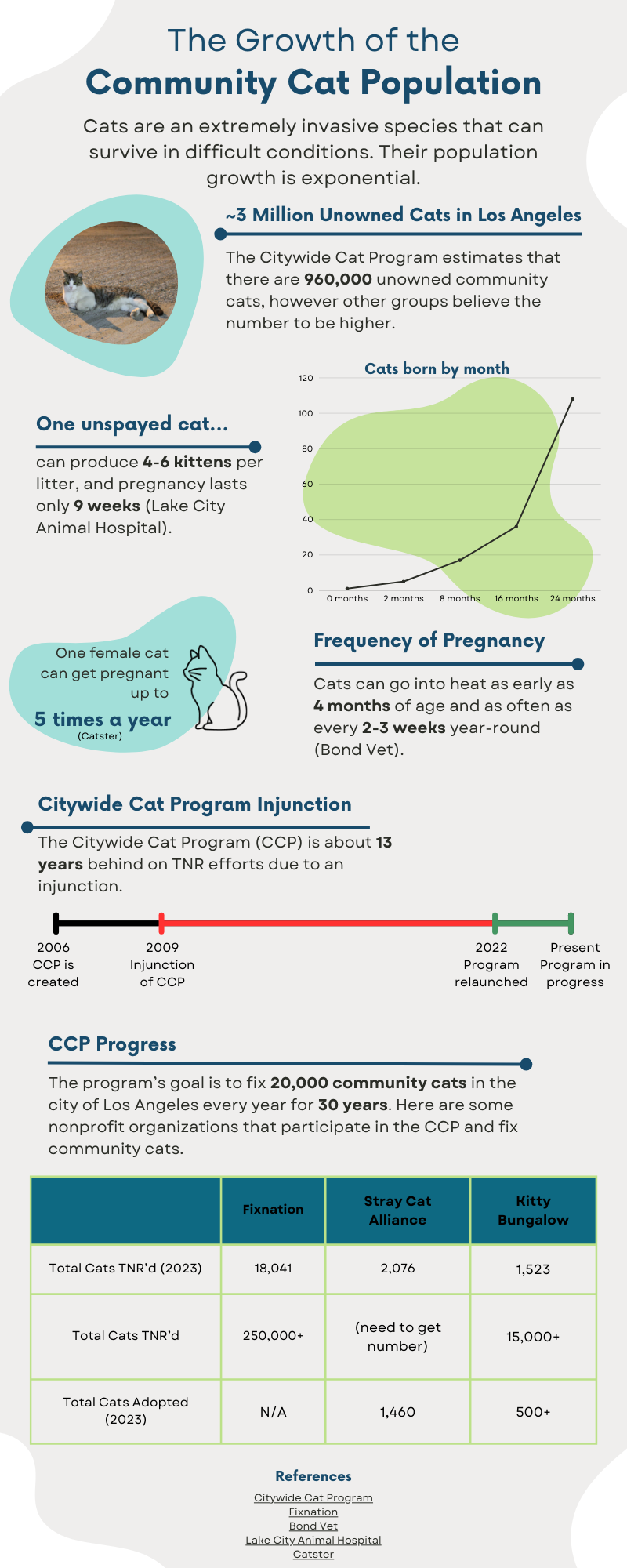
According to Karn Myers, Co-Founder and Executive Director of FixNation, there are about one to three million cats in the city of Los Angeles. That is almost as many unowned cats as there are the number of people in the city of LA, about 3.8 million people according to the Census Bureau. But a solid number is hard to pinpoint because cats are difficult to track.
Many community cats are not spayed or neutered. Chester is one of those cats. Left uncontrolled, cats reproduce at exponential rates. One cat can have an average of four to six kittens in a litter, and cats reach sexual maturity at only six months of age.
“The ones that are far along the pregnancy and large, it hurts. But what you have to think about is how many more stray cats they can produce,” said Silverman. “That helps keep you going, knowing that you are helping stray cats and not hurting them.”
Peyvand Silverman
Peyvand Silverman, a Doctor of Veterinary Medicine at FixNation – a high-volume spay and neuter clinic in LA – said that almost one out of every three female cats that she performs the spaying operation on are pregnant. And in the summer that number rises to almost every female cat being pregnant. Although it may be controversial to continue the procedure on pregnant cats, it is necessary. Myers said cats do not stop breeding without human intervention.
“The ones that are far along the pregnancy and large, it hurts. But what you have to think about is how many more stray cats they can produce,” said Silverman. “That helps keep you going, knowing that you are helping stray cats and not hurting them.”
Toni Barrett, Executive Director of Kitty Bungalow Charm School for Wayward Cats, believes that community cats have the right to live on the streets, but stressed the importance of spaying and neutering for reasons beyond overpopulation. Fixing a cat prevents cat spraying, aggression and allows cats to live longer, healthier lives.
“We really try to encourage people and let them know ‘hey, this is their home. This is where they live. This is where they thrive,’’ said Barrett. “But we do want to make sure that every cat is TNR’d because it makes them healthier.”
TNR refers to Trap-Neuter-Return. It is a process where volunteers and animal welfare workers called Trappers, humanely trap community cats. Trappers then drop off the cats to get fixed at a shelter or clinic and pick them up to return the cats to where they came from. TNR can be the key to humanely keeping the community cat population under control and the current community cats healthy. The other alternative is euthanasia, which entails putting down cats that do not have homes. This is the worst outcome for unowned cats.
Kitty Bungalow is a community cat organization and kitten socialization facility in South LA. The shelter has performed TNR on 1,523 cats in 2023. In addition to TNR, the shelter has programs like Working Cat and Adopt a Graduate. Working Cat places unsocialized community cats in barns, wineries, businesses and more to catch rodents. This prevents feral cats from getting stuck in shelters or even euthanized. Adopt a Graduate is Kitty Bungalow’s main focus – the socialization of cats so they can go to loving homes. In the last five years, about 2,500 cats have passed through Kitty Bungalow, including 1,200 working cats.
Located in North Hollywood, FixNation also performs TNR on cats. For the past 25 years, the clinic’s mission has been to fix specifically community cats in LA. FixNation spays and neuters an average of 100 cats per day. In 2023, the clinic fixed a total of 18,041 cats, and in total, the non-profit organization has fixed over 250,000 cats. The organization was getting 40% of the vouchers from the Citywide Cat Program to fix cats from the city of LA.
On a recent day, I visited FixNation where Myers gave me a tour of the clinic and their TNR procedures. With its team of 11 people and two veterinarians, everyone moved with great focus and efficiency. Myers walked me through the five stations: check-in, intake, preparation, surgery/recovery and aftercare.
Each person in the team specialized in one station, treating each cat and moving on to the next one like they were items on a factory belt. They moved efficiently, grabbing the cats firmly and placing them swiftly on sterilized metal tables. At check-in, each cat is examined to ensure they are healthy and eligible for surgery. During intake, cats are given a sedative shot, weighed and given an estimated age. Once the cat is fully sedated, it is shaved and cleaned before surgery as well as given vaccines, flea medication and additional pain medication. Finally, the veterinarian comes and performs the surgery carefully yet quickly.
I watched as Silverman cut gently into the skin of the female cat’s lower abdomen and pulled out little sacs that I learned contained undeveloped kittens. I thought I would feel sick but I was surprised at how calm she was, which caused me to feel at ease in turn. I watched three more operations. Each surgery took less than 10 minutes, and Silverman was so used to the operation that she was holding casual conversations.
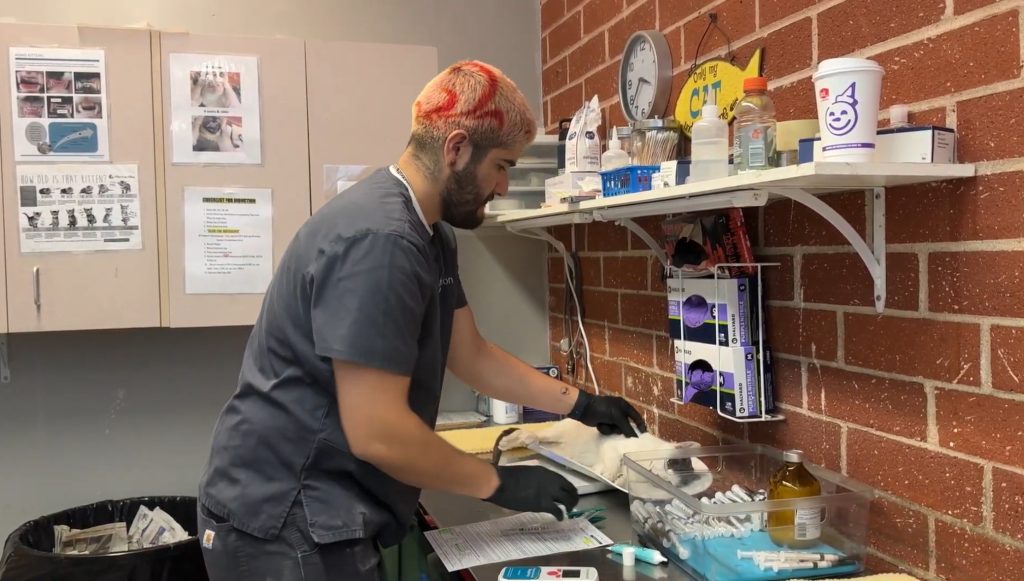
After the surgery, cats receive any additional medical attention they may need and are returned to their trap where they will wake up and remain until their Trappers pick them up. FixNation spays and neuters about 100 cats, starting at 7 a.m. and ending around 4 p.m. every single day.
“There’s nobody that does what we do that are focused on specifically community cats,” said Myers. “But each kitty that comes to our clinic is very special to us. And it doesn’t matter whether it’s a tame cat or a community cat. They’re just as important and they deserve our care.”
Even with high-volume spay and neuter clinics like FixNation and shelters like Kitty Bungalow, there is not enough support to keep the stray cat population under control.
Kitten season is starting earlier and lasting longer due to California’s increasingly warm weather as a result of climate change. There is also a national shortage of veterinarians and animal welfare centers are short-staffed to meet the demands. Animal shelters and clinics need more resources.
“I can tell you right now if you ask me, any rescue shelter, anyone and that has to do with animals, they are short-staffed,” said Barrett. “We’re still fighting an uphill battle because there is just an overflow of animals coming into the shelters.”
On the other end, cat owners and caregivers are desperate for low-cost, high quality medical care for their cats. USC student Bryan Sarabia recently adopted an unowned kitten living in the backyard of a friend’s house. Once the cat turned six months old, Sarabia got the cat neutered but the process proved more difficult than he deemed it necessary. The journalism student described the American Society for the Prevention of Cruelty to Animals’ (ASPCA) process in which the city clinic had an online waitlist that opens up every weekday at 6 a.m. By the time Sarabia opened up the website at exactly 6 a.m., the waitlist was already full.
“This wasn’t a Taylor Swift concert. This was a spay and neuter program,” said Sarabia. “Why was it so difficult to get on the waitlist?”
Sarabia ended up going to the North Figueroa Animal Hospital instead. They had a walk-in system that opened early in the morning. He was able to get his cat fixed after waiting about two hours in line.
The Citywide Cat Program is not enough.
To offset the resource problem and control the cat population, the City of LA created the Citywide Cat Program in 2006. The program would provide individuals and community groups with more education and resources to Trap-Neuter-Return community cats in the city of LA. However, in 2009, the Urban Wildlands Group and five other conservation organizations sued the city arguing that the city did not perform an environmental review before implementing the policy. The groups feared that community cats, left unchecked, would harm the bird population – which was later proven to be false. This led to a court injunction preventing the city from performing and supporting TNR efforts until a review was conducted.
“When the injunction hit, no money could be provided at all. So there was no funding from the city until within the last year,” said Myers. “And it affected us big time. We had to go find money somewhere else because we were getting close to at least a couple $100,000 a year and then all of a sudden it disappeared.”
It has taken about 13 years for the injunction to be lifted. The program has been relaunched in 2022. That means TNR efforts have been set back for 13 years.
Director of Life Saving at Kitty Bungalow Brittany Roman predicts it could take up to 20 years for the community cat population to be under control.
“It feels overwhelming. But we can’t let that dissuade us because there’s really no other option. We’ve got to get those cats fixed,” said Roman. “I know it can feel very disheartening. I guess to me, I don’t like the alternative.”
The Citywide Cat Program uses a voucher system to pay organizations and clinics $70 per cat for up to 20,000 cats per year to be fixed over a span of 30 years. Christi Metropole, CEO and President of the Stray Cat Alliance, has mixed feelings about the program.
“Do I think it’s enough? No. Is it better than nothing? Absolutely,” said Metropole. “But the Citywide Cat Program didn’t bake in a budget for real staffing and real advertising and empowering communities. So it really is up to the nonprofits.”
Metropole said that one spay/neuter operation costs about $150. FixNation’s Karn Myers said that it costs about $110. The money given by the Citywide Cat Program can only cover about half the costs. Furthermore, if people bringing in the cats do not fill out the vouchers, organizations cannot receive the money. If the money allocated to the program is not fully used, the leftover money will not be accessible to the cause.
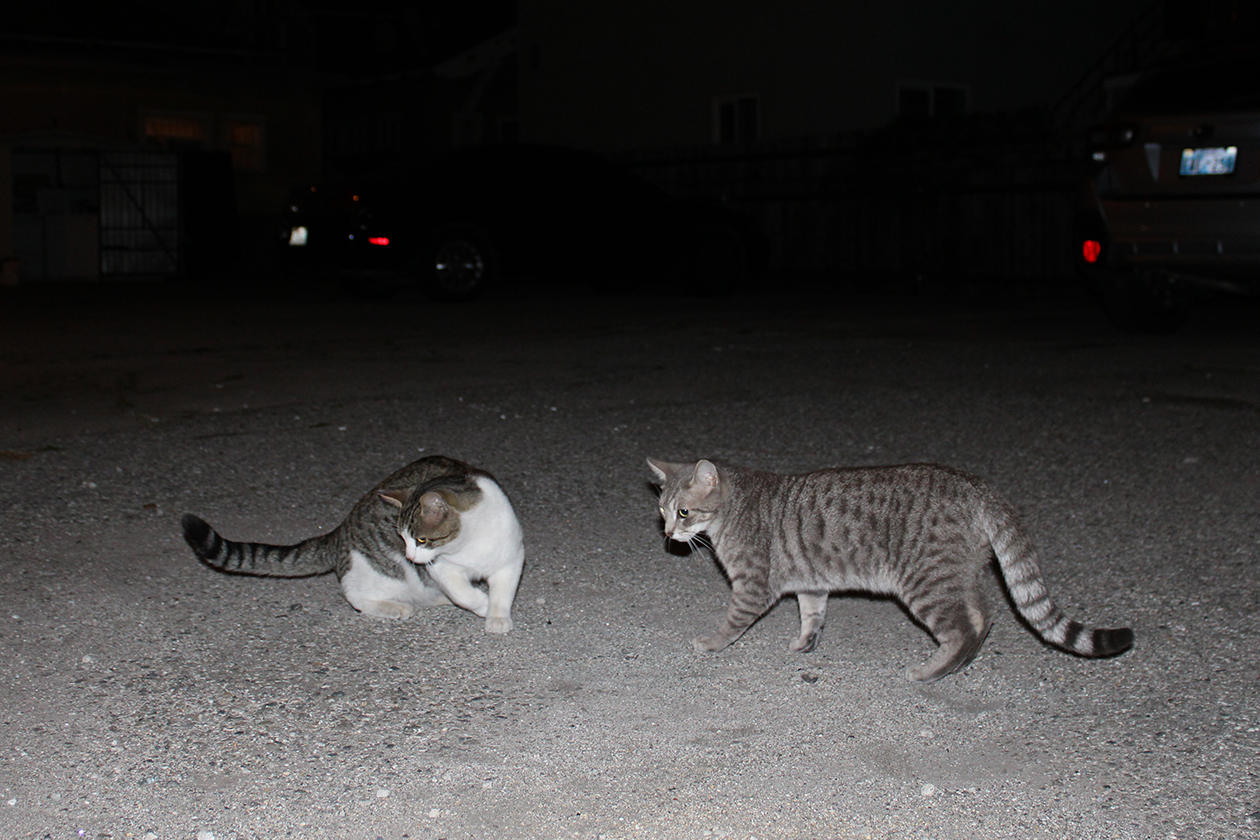
Oftentimes, non-profit organizations do not have a reliable source of funding, and so they need grants, donors and individuals to stay afloat.
“In the end, it can be a big organization or it could just be a person that comes in and became homeless handing me $1,000. But I’ll get four quarters in the mail,” said Myers. “Funding changes all the time.”
Cats like Chester cannot advocate for themselves, but hopefully, good people can be the key to their survival on the streets of LA.
“When it comes to Los Angeles, there is a lack of respect across the board for just life and boundaries and it really extends to the stray cat population here as well,” said McCardle. “It’s as simple as embracing cats and really appreciating the beauty of the mini-ecosystems and the life that is living here along with us.”
Kitty Bungalow employee Roman hopes that one day she will not have to worry about all the kittens being born outside without the proper care that they deserve.
“In an ideal world, I would love to be out of a job,” said Roman. “And that sounds terrible, but in an ideal world, I would love to not have to be rescuing kittens.”
Until that day comes, clinics and shelters will continue to TNR, one cat at a time. Slicing open the soft, sanitized flesh of a female feline and pulling out its uterus and ovaries, FixNation veterinarian Silverman carries on.
All footage and visual media taken and edited by Suejin Lim.