The one thing that every golfer needs is a golf ball. In an era of professional golf that has seen its fair share of controversy and drama, the golf ball has had its own role in the discourse about the state of the game. Courses have had to lengthen holes to accommodate the longest hitters and everyday players are overwhelmed by the amount of options and in many cases, end up using a ball that does not fit their game.
The United States Golf Association announced that golf balls will have to go through stricter testing conditions starting in 2028. The new conditions will be in effect for both professional and recreational golfers, limiting how far the ball will be able to fly.
“The longest hitters are expected to see a reduction of as much as 13-15 yards in drive distance. Average professional tour and elite male players are expected to see a reduction of 9-11 yards, with a 5-7-yard reduction for an average LPGA or Ladies European Tour (LET) player”, the USGA released in a statement.
Titleist said in a statement that they believed that elite driving distance had “plateaued”. Therefore, the company disagreed with the USGA’s new testing conditions, stating that the existing testing conditions were already effective.
Recreational golfers will be impacted less as the USGA expects amateurs to see a less than five yard reduction on overall driving distance.
“I think the pros will adapt,” said Perry Parker, professional golfer who currently plays on the Australian Legends Tour. “I think it’s a good idea just because, you know, some of the best courses in the world are getting off the lead because of the ball. A course that’s 6,800 yards or 7,000 yards should still be playable as opposed to where we have to go to 7,600 or 8,000 yards.”
Parker added that he thought the new testing conditions being put into place were decades overdue as professionals consistently hit the ball further than they have in the past.
Kevin Murphy, a design associate at Hanse Golf Course Design, places the blame on one thing for courses needing to alter their design.
“The biggest thing, I think, is the golf ball,” he said. “If they had these new TaylorMade drivers but they were still hitting a Feathery, that’s not going to do anything. It’s the ProV1 that’s, probably, the biggest culprit. I think that’s the biggest one thing, the contributing factor, to why everything feels the need to change so much.”
As a result of players being able to hit the ball further than ever, courses have had to adapt. Courses that have hosted major championships have added length, including Augusta National, the host of the Masters and Pinehurst No. 2, the first anchor site of the U.S. Open Championship.
“For the pros, you have to be over 7,100, 7,200, 7,300 [yards] which is crazy,” Murphy said. “Length is not an issue for those guys, which is part of what makes things tricky. Hazard location is key, putting those in the right place. We used to work towards, our plans would have a bunker, for a pro or the best golfer, would go at about 300 [yards], now we’re looking more at putting it at about 320 because that’s what makes them think.”
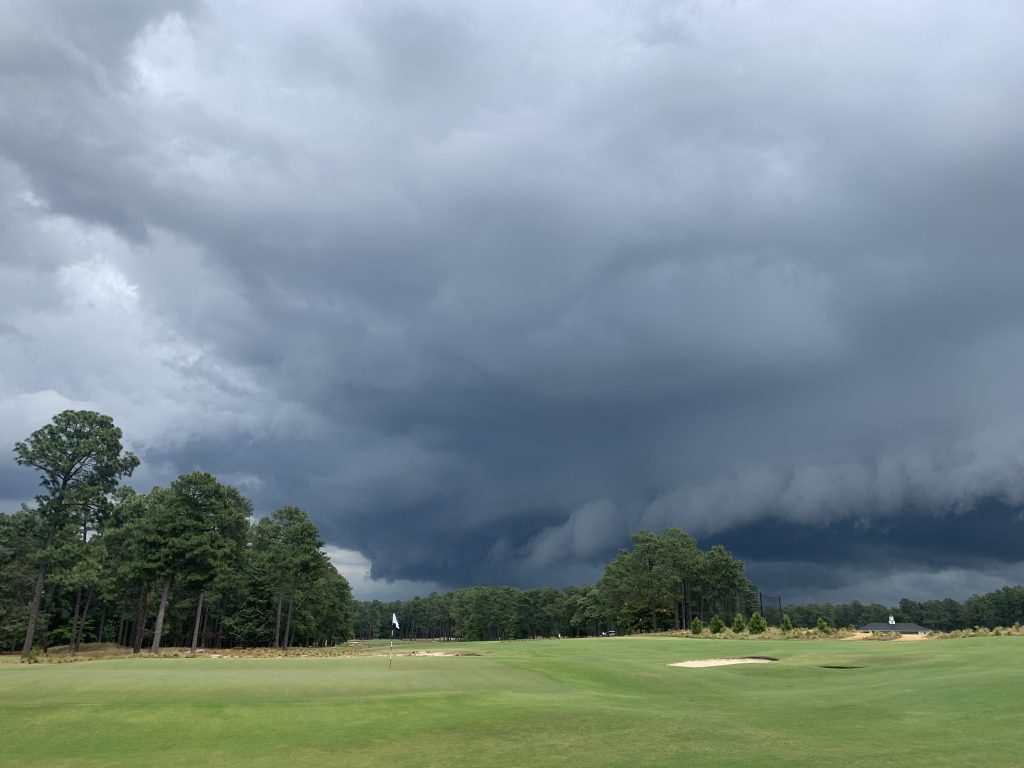
Photo: Matt Dutrisac
Murphy and his colleagues use the terms “sympathetic restorations” for bringing adapting courses to withstand modern technology while keeping the same identity it had when it was first built.
“We take the same concept that they had back then but the bunker that used to sit, in 1915, at 200 yards, we need to shift that to 250 to still be applicable today,” he said.
Stephen Kay, a golf course architect, has seen the change courses have gone through throughout his career.
“What golf clubs, not just Augusta, have done as my career started to go and the ball started going further, people started to get to a point of wanting to add yardage,” Kay said.
Kay credits Tiger Woods’ victory in the 1997 Masters as the start of the phenomenon known as “Tiger Proofing”, adding yardage to courses to make them more difficult for the rising star.
“All my clients were starting at 7,000 yards, the magic number. Now, if they didn’t have the acreage for that, whatever they were at, if they were at, say, 6,510 from the back tees, could we get to 6,600? Could they get to that next ‘hundred number’. It was very important to a point where a lot of clubs lie on what their yardage is, they do.”
Michael Croley, a freelance journalist who has written for The Golfer’s Journal, Golf Digest, the New York Times and more, has seen courses add length to keep up with the latest technology.
“I think if you look at a course like Pinehurst No. 10 that was built last year, that’s a really long course for a par-70. It’s a pretty long course for an average player. I think a lot of that was because they were sort of trying to anticipate amateur players, you know, are going to be longer. Technology’s not going anywhere.”
Parker said that he didn’t think that recreational golfers will see much of a difference with the new golf balls.
Croley said that architects will not have to adapt to the new balls more than they have had to in recent years.
“You’ll see some courses get longer, but I don’t think we’re gonna see average players who are shooting 80 and above on a 6500 yard course,” Croley said. “I don’t think, you know, in 10 years the average player is going to need a course at 6,800 yards to challenge them.”
Murphy said that there are more options than just adding length to a course to challenge the long drivers.
“Length is important, obviously, trying to keep up with technology but it’s not everything. A long course is not synonymous with a good course.”
For the amateurs, however, many are playing with a golf ball that does not necessarily pair well with their skill set, potentially holding back players’ ability to cut strokes off of their score.
“To me, it’s extremely important, said Tony Carpowich, master club fitter for Callaway. a lot of people, they’ll get fitted for clubs but when it comes to the golf ball, they just say, ‘hey look at Tiger Woods, he’s using that Bridgestone model’ you got a guy that’s a 20-handicap saying ‘oh I’ll go use that golf ball’”.
“I think most recreational golfers use the wrong ball, you know, as far as, like, getting a ProV1 or a high price ball because they usually don’t have the club head speed to get the benefit of that ball, you know. So like, if you’re gonna use a top of the line ball, you need to have at least 95 mph club head speed. That’s less than one percent of the golfers in the world,” said Parker.
Joe Gomes, Titleist’s director of communications said, “the golf ball is the only piece of equipment that a golfer uses on every shot, so a properly fit golf ball is very important for one’s performance. Titleist recommends golfers evaluate ball performance on the golf course, and offers a variety of golf ball fitting opportunities to help golfers find the best ball for their game. Once the golfer has determined the best golf ball for their game, it’s important to play with it consistently.”
Carpowich said, “there’s a lot of factors that go into the correct golf ball for the correct person. A lot of it has to do with their clubhead speed, how fast they can generate the clubhead on the golf ball so if you can’t generate the clubhead very fast but you want to go use a ball like Tiger Woods uses which is a harder compression, he likes a golf ball where he can control the spin, they go to use it and it’s not going to perform the way they think it should. It’s very important, one of the final sets when I’m fitting someone, when I gather all of their data, I’ve constructed their club for them, I know, based off of the data, I know which Callaway golf ball, I know from the data that I collected, is going to best work with their swing. We want to get the maximum spin to get the maximum control and if you don’t have the right golf ball, you can’t have that factor.”
In terms of why golfers often use the wrong golf ball, Carpowich said there are multiple factors.
“Golfers have a lot of delusion of grandeur, that’s what makes this sport so great and so freaking frustrating at the same time. We all think we can swing it 110 MPH but really, it’s only 85 MPH. A lot of people are just brand loyal too. In the industry golf is like that but same with basketball players who say, ‘I only wear Nikes’, it’s the same difference.”
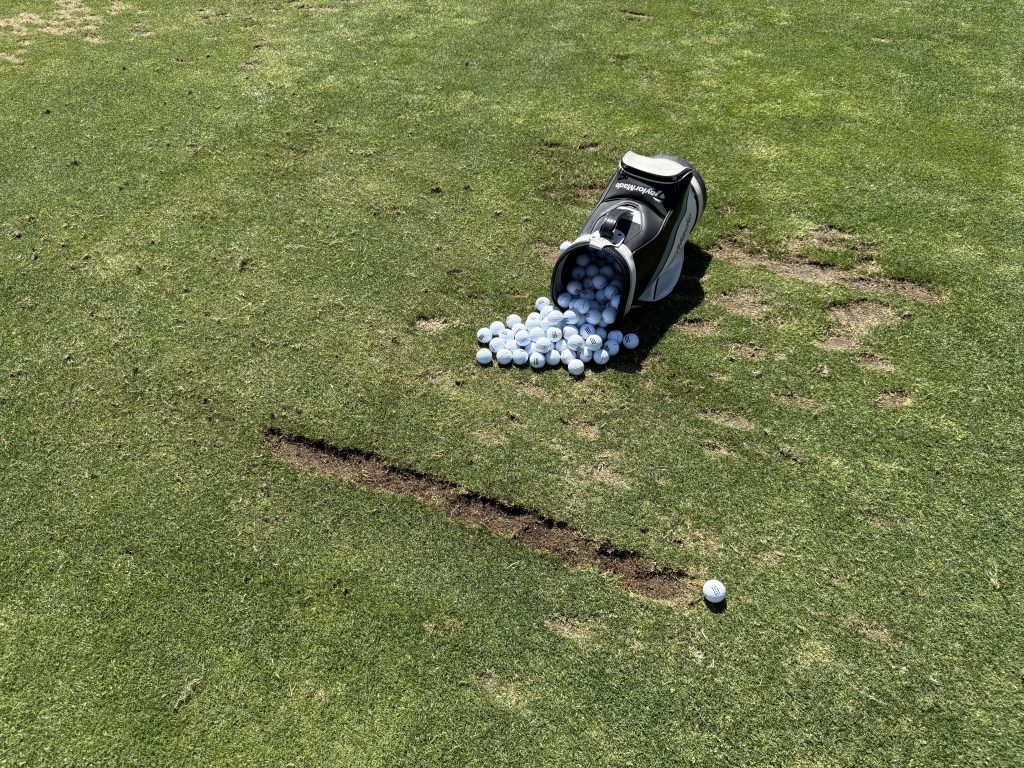
Photo: Matt Dutrisac
Despite the premier balls not benefiting recreational golfers in gaining distance off the tee, Parker said that those balls are useful around the green. The cover of some of the best balls, like Titleist’s ProV1, Callaway’s Chrome Tour and TaylorMade’s TP5 are softer, giving players more spin in their chip shots which makes it easier to stop the ball closer to the hole.
Gomes believes that premier golf balls are fit for any golfer, despite their level of skill.
“It is also important to remind players who believe they ‘aren’t good enough to play Pro V1 or Pro V1x’, that both golf balls are designed to perform for all golfers of all abilities and handicaps, different genders, and all different swing speeds. So regardless of skill level, Pro V1 and Pro V1x are the best balls to provide total performance,” said Gomes.
The advancement of the ball has been tremendous in recent years, giving golfers everywhere a boost on the course.
“I would say they’re way better, like not even close,” said Parker. “As far as how they fly, the dimple patterns and they stay in the air longer, the wind doesn’t really affect them much.”

Leave a Reply to A WordPress Commenter Cancel reply