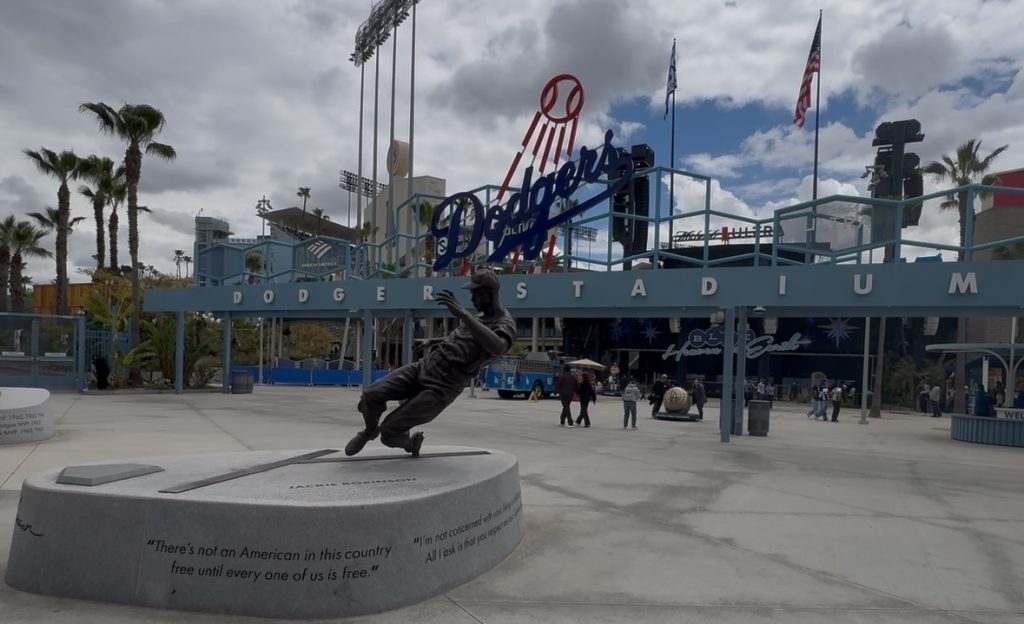
The day is April 15, 1947. A man by the name of Jack Roosevelt Robinson made his MLB debut for the then Brooklyn Dodgers against the Boston Braves – now the Atlanta Braves. Although he scored a run in his introduction to the major leagues, that wasn’t the greatest accomplishment Robinson achieved that night.
He broke a barrier unlike any other.
He broke the color barrier, becoming the first African American to suit up for an MLB franchise. Despite the intense racism and backlash, Dodger president Branch Rickey signed Robinson originally on a minor league contract in 1945 with the goal of ultimately advancing civil rights.
“Rickey played the biggest role because he took a lot of pushback from other executives,” said USC sports media professor Jeff Fellenzer. “Ultimately, Rickey and Robinson were competitors that were willing to take risks. Once that breakthrough was made, the Dodgers took a lot of pride in breaking that barrier. Not just in baseball, but in other major sports in America like the NFL.”
Robinson’s years in Brooklyn led to a lot of silverware: He was the 1947 Rookie of the Year, the National League MVP in 1949, and a six-time All-Star. In the twilight of his playing career, he also led the Dodgers to its first World Series championship in 1955.
The Dodgers, now based in the heart of Los Angeles, have not only fostered a winning culture in the core of the organization as they have won eight World Series championships; they have also continued to foster a culture of continuous diversity within their organization and the players that suit up for the Blue Crew.
“The Dodgers have done an amazing job of incorporating diversity into their organization,” said current FOX Sports journalist Rob Parker. “The team has totally embraced it. Not just by talking the talk but also walking the walk.”
Parker has covered and reported on the MLB for around 40 years, and he has seen the growth in diversity of the organization. In 2021, Parker founded mlbbro.com, a place that highlights the accomplishments of Black and brown Major Leaguers. With many coming through the ranks of the Dodgers organization, Parker partners with the MLB on spotlighting the great Black and brown ball players from both past and present.
“From a fan’s perspective, it is important to see yourself represented, especially on a team like the Dodgers,” Parker said. “You want to see someone who looks like you out on the diamond; it’s just natural.”
In his illustrious journalism career, Parker has witnessed four World Series championships won by the Blue Crew. Despite all of the victories, Parker also witnessed the infamous Al Campanis interview in 1987 live on national television.
Campanis was the general manager of the Dodgers from 1968 to 1987. He was previously a teammate of Robinson during a spell in 1946 with the Montreal Royals, a Dodgers’ minor league affiliate team in the organization. Campanis featured on ABC News’ Nightline with renowned journalist Ted Koppel, where he made racially insensitive comments about the lack of black managers and team managers at the time.
“Koppel kept trying to save him from making those comments,” Parker said. “When somebody in the organization shares some anti-Dodger views publicly like that, he just does not fit as someone to represent the organization.”
In spite of the interview, Parker believes the Dodgers have done more than enough to prove it was an isolated incident.
“It is just an unfortunate and horrible situation,” Parker said. “When I look at all of the organizations, the Dodgers are the last one in my eyes that I think wouldn’t have diversity or inclusion incorporated into its system.”
Parker is far from the only person who believes the Dodgers have made leaps and bounds to break barriers and embrace diversity.
“I think the Dodgers have tried their best to diversify in general,” said USC student and Dodger fan Joel Robles. “The Dodgers do their best to incorporate everyone.”
Robles is a native Angeleno of Mexican descent. There’s no way he could be a fan of any other team that’s not wearing Dodger blue 162 times per season.
“I think they are the most diverse club out there in American sports,” Robles said. “Fernando Valenzuela is one of the great Mexican-born ball players. I can say for a lot of Dodger fans like myself that we respect him a lot because of his background, not just from ‘Fernandomania’”.
Valenzuela began playing in the major leagues in 1981 after spending two years in the Dodgers organization as a prospect pitcher. ‘Fernandomania’ began as a craze from a mass group of Hispanic and Latino baseball fans in the City of Angels after showing out in his rookie season with the ball club in 1981. That season, he helped the Dodgers clinch the World Series – also against the Yankees.
However, prior to Valenzuela’s time in Los Angeles – much of the Hispanic and Latino fan base in the City of Angels did not see eye to eye with the organization.
As the Dodgers relocated from Brooklyn to Los Angeles in 1958, the team played its first few seasons at the Los Angeles Memorial Coliseum before settling into its homeland of Dodger Stadium in Elysian Park in 1962.
Before construction of Dodger Stadium, thousands of people resided in the grander Chavez Ravine canyon where the land was designated and bought out by the City of Los Angeles. At the time, a majority of residents were of Mexican descent. Despite a near decade-long battle with government officials, these residents were forcibly removed from the place they once called home.
“It wasn’t until ‘Fernandomania’ that you couldn’t go around Los Angeles and meet a Hispanic or Latino who is not a fan of the Dodgers,” said Dodgers fanatic David Herrera. “Now the team has more players that are adding more gas to that fire when it comes to having the organization grow over many other cultures.”
The Blew Crew have continued to find talent internationally and from various diverse backgrounds. On the team’s current 40-man roster, nine players were born outside of the United States. The team’s projected starting lineup for opening day for the 2025 season includes three foreign born players: Dominican outfielder Teoscar Hernandez, South Korean infielder Hyeseong Kim and Japanese two-way superstar Shohei Ohtani.
Ohtani arrived to the Dodgers after spending six seasons on the roster of the team’s crosstown rival – the Los Angeles Angels. During his time in Anaheim, Ohtani became the first player in league history to win unanimous MVP awards on multiple occasions. He also became the first player from Japan to lead the MLB in home runs in a single season with 44 in 2023.
Off the field, Ohtani’s jersey reportedly garnered the most amount of sales out of all major leaguers.
“Ohtani is my favorite player,” said Orange County native Bryan Takeshita, who is of Japanese descent. “I stayed outside Dodger Stadium for almost three hours waiting for his bobblehead. It’s great for the game of baseball as well as the representation of the Dodgers that the team has him and [Yoshinobu] Yamamoto.”
Because of his marvelous play with the Angels, the Dodgers broke the bank for the two-way sensation. Ohtani put pen to paper on a massive 10-year, $700 million fully guaranteed contract. At the time, it was the largest contract ever given out to any player in any of the major American leagues. It was until the New York Mets dealt a 15-year, $765 million contract to Dominican outfielder Juan Soto. It goes to show the respect and the admiration that the Dodgers as an organization have on players from diverse backgrounds.
“The team’s recruitment starts from the foundation,” Robles said. “It starts from going international and getting prospects. I believe the team acquired another prospect from Africa. I believe the fanbase is growing because of these acquisitions from abroad.”
During the most recent annual international signing period in the MLB, the Dodgers scooped up 29 amateur free agents, including Japanese pitcher Roki Sasaki, who was ranked as the No. 1 international prospect during the cycle. The Blue Crew recruited 12 players from Venezuela, eight from the Dominican Republic, four from Mexico, two from Colombia, and one each from Japan, Panama and South Sudan. At 17 years old, South Sudanese pitcher Joseph Deng Thon became the first player from his nation of birth to sign a contract in the major leagues.
The Dodgers are setting an example in smart recruitment strategies while also recruiting some top-end talent from abroad. The Blue Crew became the first MLB franchise to open up its own academy in the Caribbean as the Blue Crew opened up Campo Las Palmas in the Dominican Republic in 1987.
“The Dodgers have always been about finding players that can help contribute to the organization,” Fellenzer said. “Regardless of race or background, the team took a global view and took those steps of looking internationally when other teams just did not make that same investment.”
But it is not just the players who have diversified for the Dodgers as an organization.
The Blue Crew hired its former outfielder Dave Roberts as team manager in 2015, its first minority team manager in team history. Roberts – who is the son of a Japanese mother and an African-American father – has led the Blue Crew to two World Series championships in 2020 and 2024. After the second World Series, the Dodgers have put deserved faith into their manager, putting pen to paper on a four-year, $32.4 million contract. Roberts broke the record for highest annual salary of any team manager in MLB history.
This implementation of diversity and inclusion has also gone beyond the dugout for the Blue Crew.
In 1958, the Dodgers became the first MLB team to hire foreign language radio announcers. The team hired its first full-time Spanish broadcaster, René Cárdenas from Nicaragua. One year later, the organization paired him with Ecuadorian sports broadcaster Jaime Jarrín to call their games. The Ecuadorian would end up staying in the booth in Dodger Stadium for 64 years until his recent retirement in 2022 – including being paired with Valenzuela for 12 years.
The Dodgers’ ownership group has also incorporated diversity. Former Los Angeles Lakers superstar Earvin ‘Magic’ Johnson became the first Black owner of the team after acquiring it as part of the Guggenheim Baseball Management Group in 2012. Former tennis stars Billie Jean King and Ilana Kloss became the first women to buy a minority share of the team in 2018, of which they still own to this day.
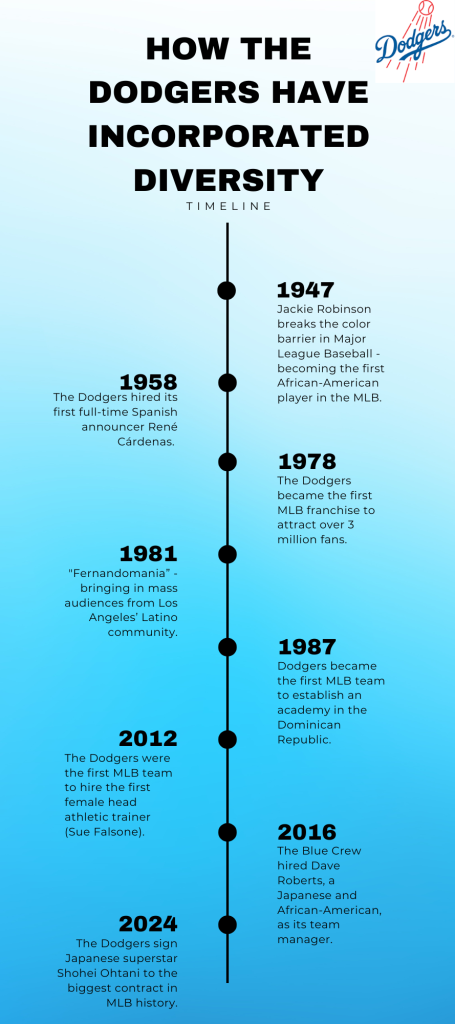
The Blue Crew started its own Diversity, Equity and Inclusion Committee in 2020. Its mission: to create a culture where diverse voices and experiences are valued.
“Players who wear that Dodger uniform are proud to wear the uniform because the Dodgers were and are the franchise that is not afraid to change this country and change this world,” Parker said. “The Dodgers are a proud franchise, and a lot of its pride originates from breaking the color barrier.”
The Dodgers honored Robinson’s contribution and dedication to the game of baseball by building a statue outside center field in Dodger Stadium on the 70th anniversary of his debut – one that highlights the accomplishments of an ever-lasting legacy.
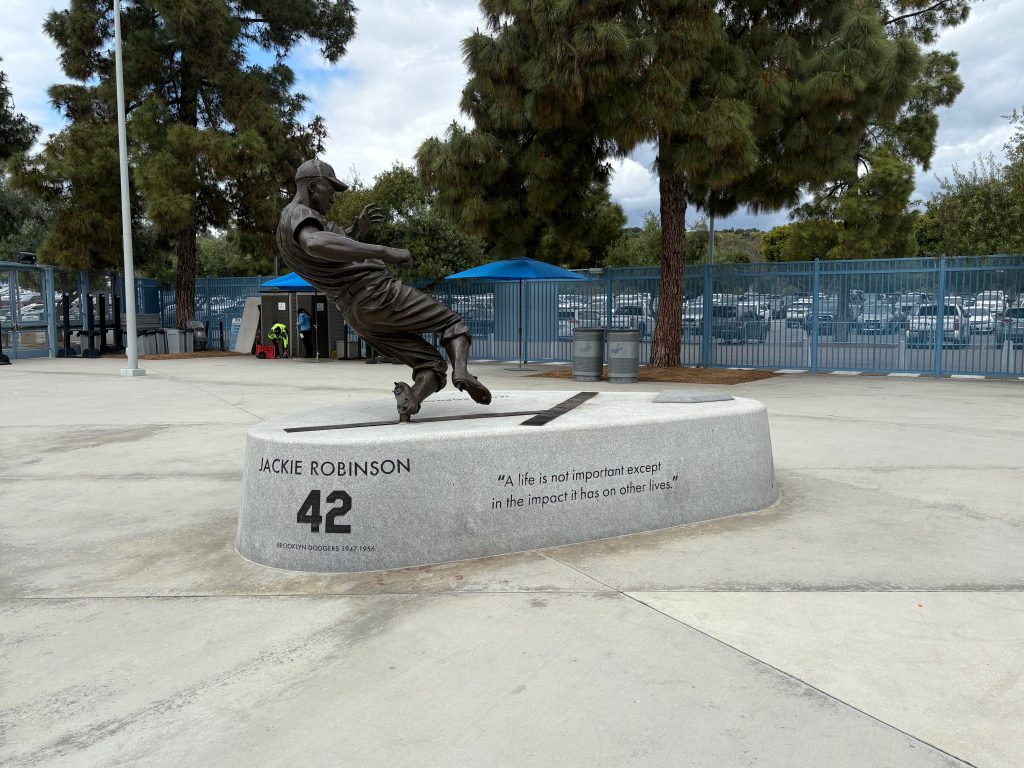
“In today’s game, there are players from all over the world that represent the MLB,” said Dodger fan David Kenneth. “It all stems back to players like Jackie Robinson who constantly suffered from outside that eventually paved the way for this league to be as diverse as ever. This statue in front of us represents his contribution to baseball.”
Now every April 15, the MLB honors Robinson’s legacy with every player wearing his iconic number 42. All because the Dodgers and Robinson broke barriers of diversity.