As public confidence in higher education falls, USC students and political experts weigh the personal, financial and cultural complexities of pursing a degree at one of America’s most elite – and expensive – universities.
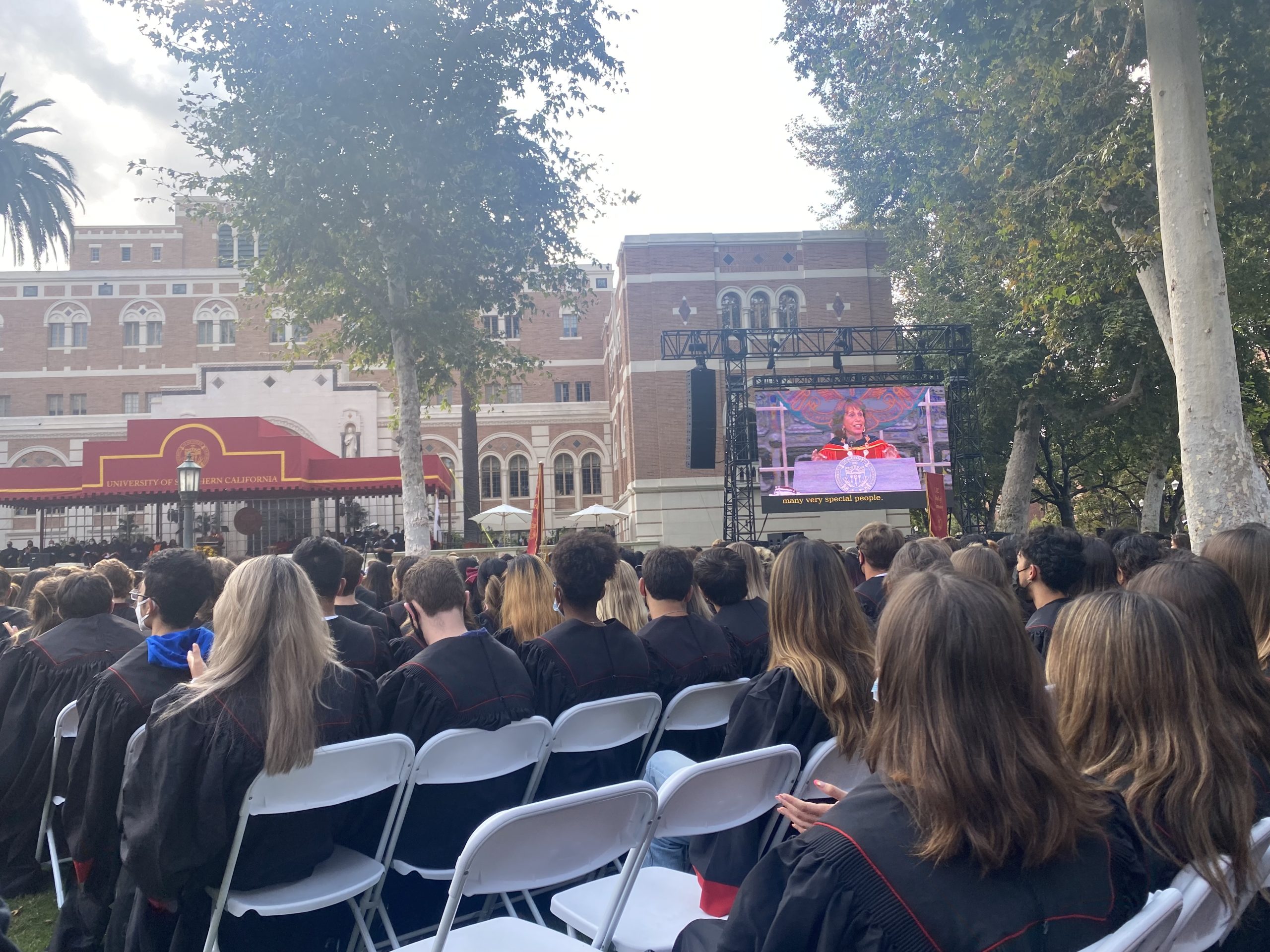
By: Jacob Wheeler
In May, University of Southern California senior Alyse Saucedo will earn her undergraduate degree, exiting an elite circle and entering a society that’s never been more skeptical of higher education.
Saucedo, 21, grew up in San Diego and attended an all-girls college preparatory academy. In her upper-middle-class neighborhood, going to college was not up for debate.
“It was always expected of me that I was going to go, but not only that, that I would surpass whatever they had accomplished,” she said. “My family very much emphasizes a legacy of generational progress, and so I was definitely a part of that.”
Her flawless academic record led to offers from schools across the country, including Princeton University.
Money, she said, and a fear of disappointing her parents, proved to be stressful.
“I think the anxiety that was rooted in all of that is, ‘can I afford the school that I worked so hard to get into?’” she questioned.
Millions of families are asking that question. As student debt soars and political divides deepen, public confidence in higher education is plummeting to unprecedented lows, a 2023 Gallup survey shows.
About 46 percent of parents would not send their children to a four-year college even if they had the financial means to do so, according to the Hechinger Report, which covers innovation and inequality in education.
Another survey commissioned by the Carnegie Corporation of New York revealed a racial gap. Public confidence in higher education was highest among Black families while support among white and Hispanic parents stood at 51 and 56 percent, respectively.
In many respects, Saucedo, a Hispanic-American herself, grew up in the famed cross-town rivalry. Her father attended USC while her mother studied at UCLA.
Charting a unique path, the philosophy, politics, and law major described USC as a “bubble.”
“I think recently, college and higher education has become that of the elites, the snobby elites, and it’s not relatable. It’s not attainable to a lot of people,” Saucedo asserted.
Historically known as a playground for the wealthy, USC has made strides in diversifying its campus.
In 2023, the university accepted 9,277 students, according to Annenberg Media. About one in four were the first in their family to attend college and a third identified with a historically underrepresented racial or ethnic group.
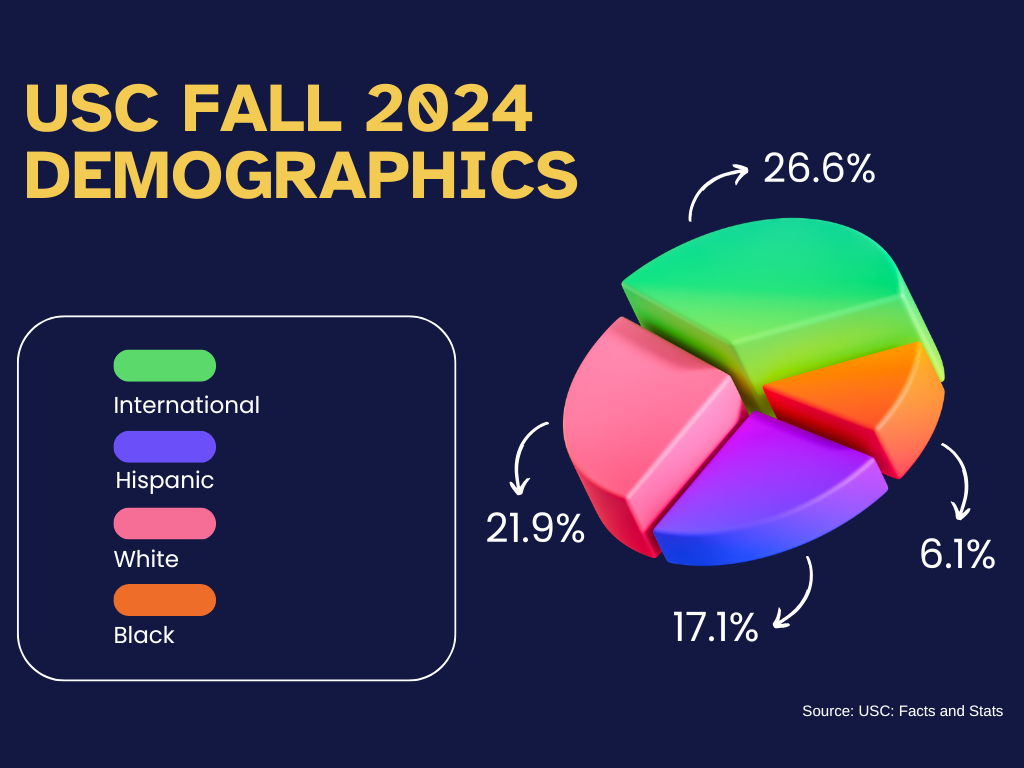
Infographic: Canva
Students keep coming to schools like USC because, for many middle-class families, a degree has longed marked a reliable path to social mobility.
California workers with a bachelor’s degree, for example, earn a median annual wage of $81,000, according to the Public Policy Institute of California. Only 12 percent of adults with a high school diploma make that kind of money, which falls to 6 percent among workers with no formal education.
The Battle Over Free Speech
The economic incentives attracted Logan Barth, 21, who said moving to Los Angeles was “really exciting” after spending most of his childhood in the Northern California suburbs.
USC’s New Student Convocation in August 2021, he said, reflected a fresh start.
“That was such a tangible event that marked the beginning of a new era in my life that was so radically different from the previous eras of my life,” he said.
In the months that followed, he climbed the ranks in student government, joined the Mock Trial team and became involved in Jewish student organizations.
After the Hamas-led attacks on Israel that killed 1,200 civilians and took hundreds others hostage, Barth described the protests that followed as a “low moment.”
“I walked out of Hebrew class last year, and the campus descended into complete chaos,” he said. “That was a shocking and very sad moment. And it was sad because I had a personal attachment to the thing they were protesting against.”
The Oct. 7th attacks triggered a massive Israeli military offensive in Gaza, which has killed thousands of Palestinians.
A surge in antisemitism and the cancellation of a Pro-Palestinan commencement speaker sparked a heated debate over free speech that tore the picturesque campus apart.
“I believe that there’s a big free speech issue on college campuses,” Barth asserted.
In September 2024, the Foundation for Individual Rights and Expression ranked USC as one of the worst schools for free speech nationwide.
That semester, he graduated and enrolled into the USC Gould School of Law.
“I think college is worth it, because it helps me grow in a professional sense, it allows me to get three years of just personal development as a human being,” Barth said.
He also had a message for some of his peers back home.
“It’s not a bad thing if people don’t want to go to college,” he said. “They have other sets of skills and other things that they’re mentally stronger on than people who do go to college.”
Despite the attention on elite college campuses, it’s actually those without a college degree who hold the most sway in America’s political discourse.
National CNN exit polls highlight how education status is a strong indicator of voting behavior. In the 2024 general election, about 6 in 10 voters did not have a college degree.
These voters heavily backed Donald Trump, while a smaller percentage of college-educated voters supported Kamala Harris.
The turnout surge in mostly white, working class and rural communities hints how elite academia’s influence may be waning.
Dan Schnur, who teaches political communication at USC and UC Berkeley, said the education divide is defying traditional voting patterns.
“In this last election, we saw Trump doing far better with young men who did not attend college, not just young white men, but young Black and Latino men as well,” Schnur said. “That’s something that we’ve seen occasionally in American history, but never to this degree.”
While young voters shifted away from Democrats, Schnur said college campuses themselves have not necessarily become political battlegrounds.
“The overall trend on college campuses is for the students to lean leftward, although there are obviously exceptions to that, but where we’ve seen the contest, the fight for young people’s votes become most intense is among the ranks of those who are college age, but who, for whatever the reason have chosen not to attend college,” he said.
USC, with an admission rate falling to the single digits, is more selective than most. In 2022, only 13 percent of universities rejected more than half of their applicants, according to the American Enterprise Institute.
“When we talk about the potential cultural disconnect between higher education and the community at large, we’re actually talking about an extremely small subset of the higher education community,” Schnur said.
The Money Factor
USC stands out as one the least affordable options for working class families. On March 12th, the school hiked tuition for the upcoming academic year, pushing the total cost of attendance to nearly $100,000.
U.S. News and World Report in 2024 ranked the Southern California campus as the most expensive school in the nation.
More than two-thirds of undergraduate students receive some form of financial aid, the university claims, which includes need-based grants, merit scholarships, loans and federal-work-study programs.
“We understand that a college education involves a significant investment of resources for both students and families,” the school said in the statement. “The last thing we want, however, is for cost to prevent a student from enrolling at USC.”
Financial aid, however, does not appear to be easing economic anxieties. Only 33% of working class people believe public universities are affordable, according to the National College Attainment Network.
The high sticker prices have pushed many to seek alternatives, like the Los Angeles Community College District, which serves about 200,000 students across nine campuses.
Juliet Hidalgo, Director of Communications and Marketing for the LACCD, said every applicant receives admission and most study for free.
“We serve probably the most underserved communities in the urban nation,” she said.
Hidalgo called out “higher education lies” and insisted students don’t need a four-year degree to live comfortably.
“If you look at Trade Tech, which is our technical school, the linemen or the line workers come out and make six figures right off the bat,” she said.
Hidalgo added that the public’s perception is the biggest challenge community colleges face.
“I think a lot of people kind of opt out of community colleges, you think you’re somehow less than if you go to a community college. It’s like a lie that we all believe.”
Although a changing job market, she said, has helped break the stigma, attract the working class and rebrand as an appealing alternative.
“We need people who understand, you know, like electrical things. We need people that understand auto mechanics, you know what’s going on with AI,” she asserted.
“That’s what’s really expanding right now in the market, less the four year.”
Whether a student goes to a four-year program or community college, there’s a direct correlation between confidence in higher education and return on investment.
Engineering and computer science students, for example, score the highest rate of financial return, according to an American Educational Research Association analysis. Humanity majors, on the other hand, have a significantly lower rate of investment.
USC paid off for Darrielle Fair, the new political reporter for Spectrum News North Carolina, who secured enough scholarships to graduate from the Master of Public Policy program.
A first-generation college student, Darrielle said she pursued the degree to gain “an edge in reporting and journalism.”
Meanwhile, she struggled with imposter syndrome and a fear of failing.
“Overcoming those challenges was being able to understand that I couldn’t walk the journey alone, and I did have to rely on my peers,” she said.
That network, she said, and the hands-on experience in the Annenberg Media newsroom, put her on the right path.
“It truly prepared me to kind of make a vertical move a lot quicker than other individuals in my particular industry were not able to make,” she said.
Back in University Park, there’s widespread sentiment that USC students pay for more than an education.
“While the cost is not worth it, I wouldn’t change anything, because it was an amazing three years of my life and something I’ll cherish,” Barth said.
Coming to college provides unique experiences and pushes young people to think critically. USC, for example, says the school’s central mission is “the development of human beings and society as a whole through the cultivation and enrichment of the human mind and spirit.”
Still, the credibility and financial security of these institutions remain in limbo.
On March 24th, USC joined other colleges in implementing sweeping budget cuts and a staff hiring freeze, according to NBC4 Los Angeles. The cost-cutting measures come as the Trump Administration threatens to pull federal contracts from private and public universities.
For those willing to look past the political rancor and steep sticker prices, a college campus does provide young people with exclusive experiences. Undergraduate students have up to four years to create a professional network, cherished memories, lifelong friendships and even meet the love of their life.
The Institute of Family Studies found that colleges can be an ideal place to find a soulmate. About half of USC graduates go on to marry fellow Trojans, according to the study.
“I think college is more than just an education. I’ve grown so much in my own person, in my relationships, who I rely on, who I come home to,” Saucedo said with a smile. “I’ve created a family here.”
Comments are closed, but trackbacks and pingbacks are open.