
Making The Call
Navigating The New Era of College Athletics
Racin’ Through The NCAA
By Dylan Brashier
College football now operates like free agency, but the people navigating it are still students and families, not professionals.
At the center is one athlete’s transfer portal journey, told alongside his family’s experience as they travel across the country, weigh offers, and make life-changing decisions in a matter of days.
Because this isn’t just about players entering the portal. It’s about the people around them — parents, agents, coaches — all navigating a system that moves faster, costs more, and demands more than ever before.
“As soon as I committed, I felt sick to my stomach.”
Racin Delgatty was lying on a hotel bed in Westwood, less than an hour’s drive from his family home with his parents, Grant and Frances, his hands covering his face. UCLA coaches were downstairs waiting to celebrate. Dinner reservations had been made. After a week of black Escalades, nonstop meetings and cross-country flights, the transfer portal had finally led the Delgatty family to the light, but the La Cañada native had a gut feeling something was wrong.
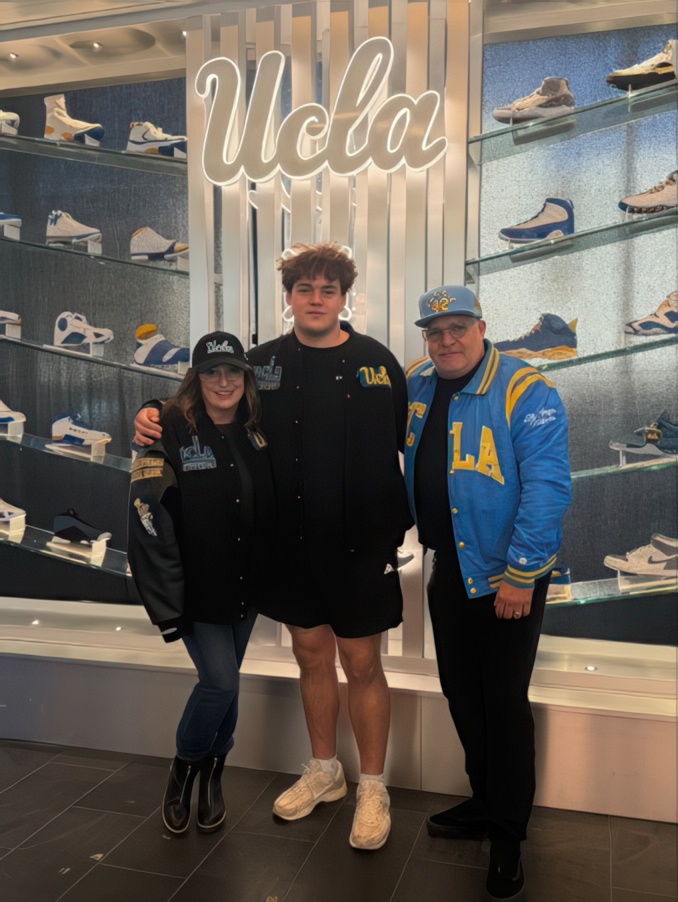
Courtesy of Grant Delgatty.
“My parents were like, ‘What’s wrong? This is your dream school. What’s going on?’” he said. “I just had this gut feeling.”
Thirty minutes later, the phone rang.
UCLA’s head coach, Bob Chesney, called, saying admissions had reviewed his transcripts. The commitment would not stand unless he returned to Cal Poly and retook two classes.
In less than an hour, a decision months in the making unraveled, another reminder that in college football’s new transfer era, nothing is final until it actually is. The news came after a strenuous journey for the Delgatty family, traveling across the country and visiting schools in a new state each day.
“It was overwhelming,” Racin said. “It was really tiring… it’s breakfast, meeting, fly, land, not a lot of sleep and wake up early for more meetings.”
The whole situation was uncharted waters for Racin and his parents, as the three-star recruit was living the “SLO” life, attending Cal Poly San Luis Obispo for the three years prior to his transfer portal expedition. Despite getting playing time his first year and gaining the starting center role his second, Racin always had hopes for something more.
With three years of eligibility left, Racin had to decide whether to stay and work on raising his stock or take a chance on the transfer portal.
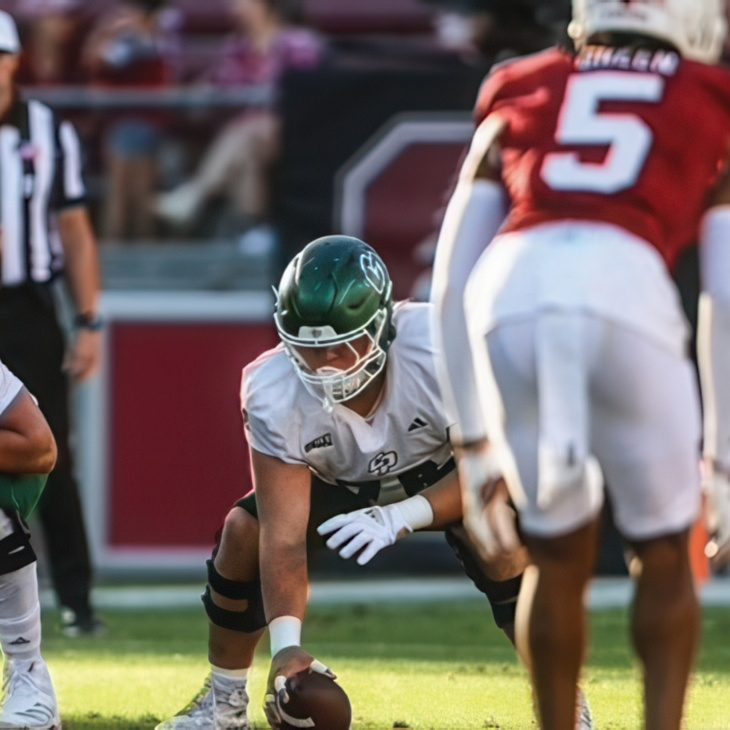
Courtesy of Grant Delgatty.
Racin stayed and grinded, cementing himself as a top center at the FCS level, allowing just one sack over 1,316 offensive snaps, per 247Sports. With Racin playing at the top of his game, his team couldn’t match it, finishing 4-8 last year and 3-8 the year before.
Racin knew it was time to move on.
“He went into the coach’s office the day after their last game to tell him he was going to enter the portal,” Grant said. “And the coach got a phone call and was fired while [Racin] was in the office… that was kind of crazy timing.”
With a new coaching regime coming in, it was the perfect time for Racin to enter the portal, but when the time came, a brutal reality set in.
“I was told, ‘Be ready, your phone’s gonna be blowing up,’” Racin said.
Expectations turned to disappointment when his phone wasn’t buzzing with offers when the portal first opened.
“We were kind of freaking out because his phone really wasn’t ringing,” said Grant.
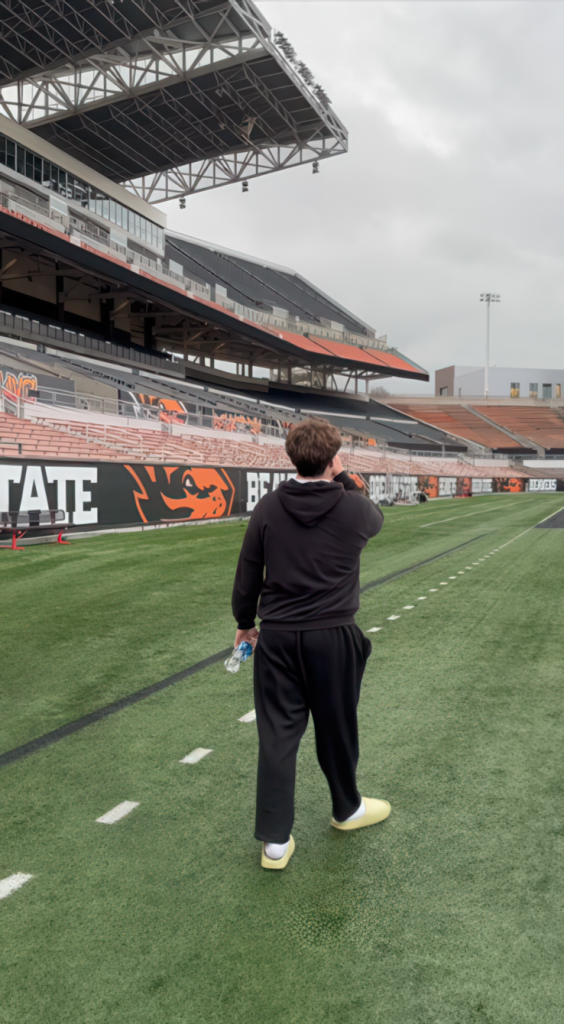
More radio silence followed the next day, but finally, late on January 3, Racin’s agents called and said that Oregon State wanted him to visit.
“The bigger schools… slowly get down to FCS guys… then they saw me and were like, ‘Oh, it’s a hidden gem,’” Racin said.
Once he got that first call, the snowball effect was in full swing, and the family was about to embark on a journey that would test their limits, but ultimately bring them closer together.
Racin knew this was just the first of many visits, so he wanted to use his trip to Oregon State as a learning opportunity.
“I kind of went there knowing I wasn’t going to commit… I thought it’d be a good practice run,” Racin said.
While checking out the facilities, Racin was meshing well with the coaching staff, but then got another call from a different OSU, Oklahoma State, and they wanted to see him the next day.
Oregon State’s staff didn’t want Racin to take that visit, and it came at a cost.
The Beavers filled the position that was offered to him less than 24 hours later.
“As a parent, we were scared to death, it’s devastating,” Grant said. “We thought he would have a little bit of time to think about it.”
But the stress didn’t stop there. Oklahoma State had better facilities than Oregon State, but Grant said the coaches didn’t fully connect with Racin.
“You gotta remember, he keeps getting phone calls and texts saying, ‘We want you, we want you…’ So we left Oklahoma State and went to Kansas.”
With Kansas being just a three-hour drive from Oklahoma State, Racin and his parents were picked up in a private black Escalade and taken to their next destination. While on the way to Kansas, Racin found out Oklahoma State had already filled his spot too.
After a successful visit to Kansas, more calls came. This time, Michigan wanted Racin to visit.
“That’s a good offer, so he agrees to go on the Michigan visit,” Grant said. “And now meanwhile Kansas is like, ‘Hey, just so you know, I’ve got other guys lined up… we want you, but if you don’t accept this, we’re going to move on.’”
With airfare booked and everything lined up for Michigan, all of a sudden UCLA called and said they were really interested in Racin. With UCLA being in the Delgattys’ backyard, it felt like a slam dunk, so the family decided to skip Michigan and head back to the West Coast.
“I told the Kansas coach, ‘I really like this place, I’m planning on committing, but I just have to check UCLA because that’s home,’” Racin said. “Then we landed in our layover and I had all the coaches texting me screenshots of the new center commit at Kansas. It was pretty crazy.”
Three offers, three visits, all off the table after three days. But the Delgattys continued the trek to find Racin’s future school.
With no time to dwell, the next opportunity was already waiting. Colorado had already reached out, and with Deion Sanders leading the program, it was one of the most important offers on the board.
But Racin decided to head to Los Angeles first.
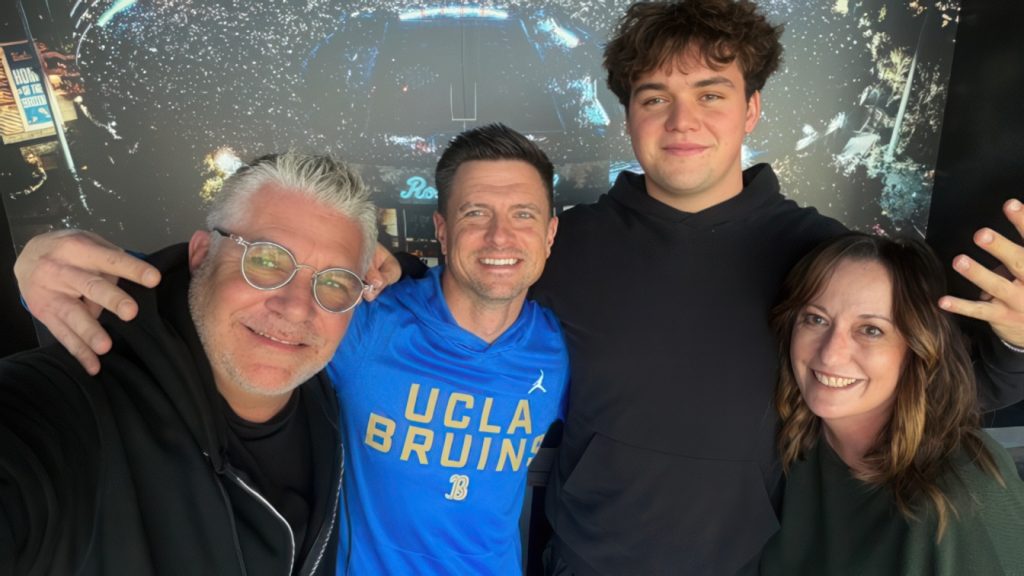
Courtesy of Grant Delgatty.
The Bruins offered something none of the other schools could: familiarity, comfort, and a chance to stay close to family while competing at the highest level.
After days of constant travel and uncertainty, it finally felt like things were slowing down. That’s what made the moment in Westwood feel so certain, until it wasn’t.
Despite Racin’s intent to commit, Coach Chesney broke the news that the university couldn’t accept Racin’s transcripts, adding more fuel to an already chaotic recruiting trail.
“We were sitting there in the hotel room in pure panic,” Frances said. “We didn’t have anything else locked in… and none of us were in control of it.”
With UCLA out of the question, Colorado was still on the schedule. Flights hadn’t been canceled, but the clock was ticking before the recruiting dead period, when teams couldn’t interact with players.
While rushing out of Westwood and sprinting through LAX, Racin got a text from Alabama asking if he could visit later that week. Now, the process had reached another level. But Colorado came first.
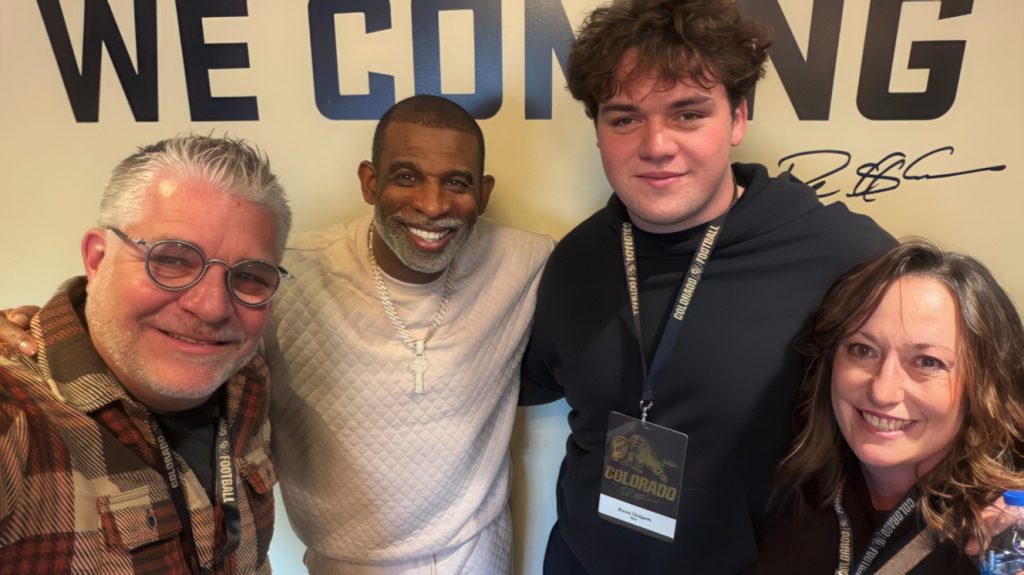
The Delgattys boarded a plane to Denver, and by the next morning, they were sitting across from NFL Hall of Famer and head coach Deion Sanders.
From there, the visit only escalated.
“We’re sitting there with Deion Sanders… and then he’s like, ‘Let me show these guys around,’” Grant said. “So he takes us on a tour with his whole entourage… and one of the guys whispers to me, ‘He never does this with recruits… you guys must be special.’”
From the moment they arrived, Colorado leaned in. Coaches filled entire rooms at breakfast. Staff followed them from building to building. Even Sanders himself stayed with them through meetings, tours, and meals, something the family was told rarely happened.
“[Sanders] said, ‘Your son’s the best center in the portal, hands down,’” Grant recalled.
Courtesy of Grant Delgatty.
It was the kind of validation that had been building all week, now delivered by an NFL legend.
“It was very surreal,” Grant said. “You’re just kind of like… what’s going on here? This is crazy.”
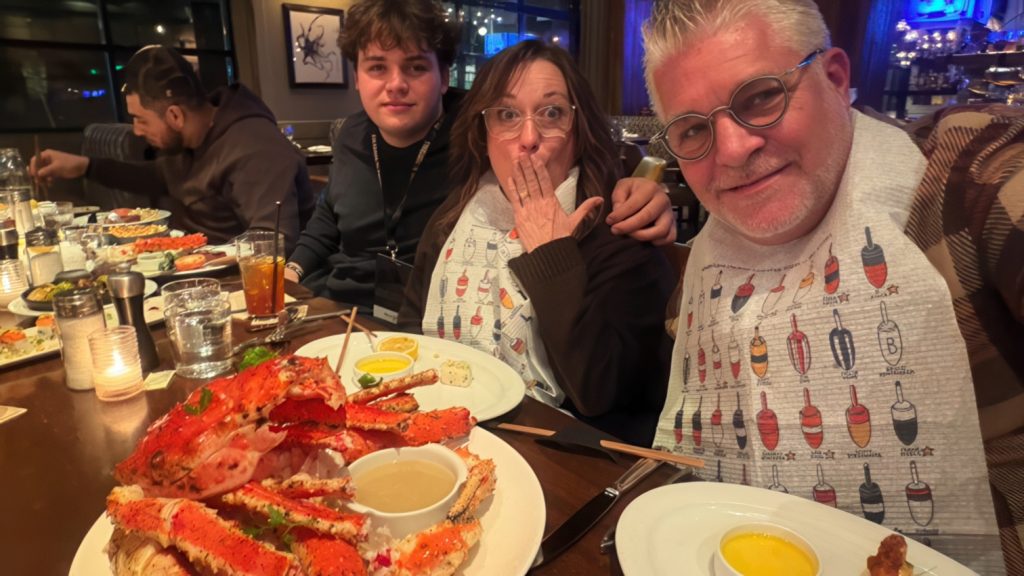
The trip only got crazier when dinner time rolled around.
Courtesy of Grant Delgatty.
“They ordered us an entire Alaskan king crab… like a seven-pound crab,” Grant said. “There was so much food we had to get other people to eat it.”
By the time dinner stretched into the night, the schedule had already slipped.
“They took us out to dinner… and we were supposed to leave that night,” Grant said. “I didn’t want to rush this… let’s just stay.”
So they did, and Colorado handled the rest.
“They put us up in a hotel and got us on a flight first thing in the morning,” Grant said.
Colorado checked off all the boxes for Racin too.
“Yeah, I loved Colorado,” Racin said. “Everything about that visit was good. The coaches were amazing.”
The decision felt easy.
“When I was in my hotel in Colorado… I was telling my friends, ‘Yeah, I’m going to Colorado. I’m going to commit.’”
But even in that moment, the stakes were impossible to ignore.
“They were offering like an extra $100,000 if I didn’t visit Alabama,” Racin said.
It wasn’t just an offer, it was leverage. Money to limit options, but could end the process early. This is what the new world of college football looks like.
In the NIL era, recruiting isn’t just about selling a program, it’s about building a roster in real time, with money shaping it. Teams aren’t just competing for players anymore, they’re competing to control the process itself.
“The Alabama O-line coach found out I was really thinking about Colorado,” Racin said. “He blew my phone up… blew my parents’ phones up, saying, ‘Why wouldn’t he come to Bama?’”
With Racin holding the cards for the first time all week, the Delgattys chose to slow things down. Colorado was still on the table, but instead of committing on the spot, Racin stuck to the plan and headed home. The transfer portal entered its three-day dead period, a window where no visits could take place, and for the first time all week, everything stopped.
No calls. No meetings. No pressure.
The week had started with no clear destination, bouncing from state to state, chasing opportunities that disappeared just as quickly as they came. Now they were back home, trying to process everything.
“Had it been any earlier, it wouldn’t have worked. Had it been any later, it wouldn’t have worked,” Grant said. “But it was perfectly shoehorned in.”
Real life crept back in.
Grant, a professor at USC, returned to the classroom. After a week of cross-country flights and recruiting pitches, he was back teaching, a reminder that the family was still balancing real life.
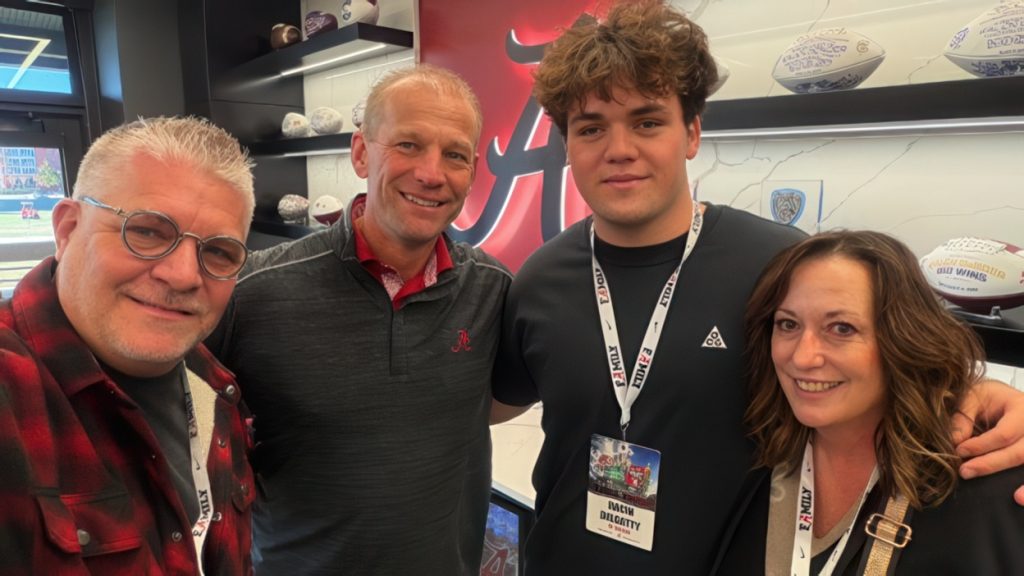
But even then, the decision wasn’t made, and there was still one more visit waiting. So the Delgattys headed to Tuscaloosa, for hopefully the last recruiting visit.
Courtesy of Grant Delgatty.
They were invited to spend time with the staff, including dinner at head coach Kalen DeBoer’s house. From there, the scale of Alabama revealed itself.
“It was such an impressive visit… the facilities, everything about it was incredible,” Grant said.
For a player coming from the FCS level, the jump to a program like Alabama, one of the most historic and successful in college football, wasn’t just another step. It was a leap into a different world.
“[Coach] said going into spring ball I’d be the starter… but you’ve still got to work for it,” Racin said.
There were no guarantees, just an opportunity.
“Alabama has the most offensive lineman in the NFL,” he said. “I really wanted to go to Colorado… but I was betting on myself.”
After the flights, the pressure, and the uncertainty, the decision didn’t come down to comfort. It came down to trust.
“I was just in God’s plan,” Racin said. “The way I ended up at Alabama… it was insane.”
Courtesy of Grant Delgatty.
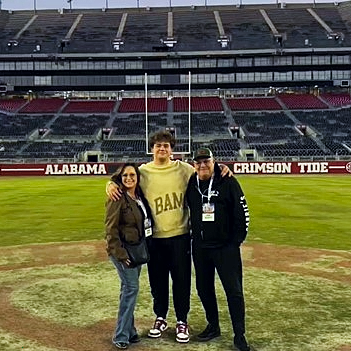
After weeks of chaos, Racin Delgatty committed to Alabama and he enrolled in the spring semester, still on track to start.
But the decision wasn’t just about football. It was about navigating a system that no one in the Delgatty family had experienced before.
In a matter of weeks, they went from waiting for a call to crossing the country, making life-changing decisions in hotel rooms, airports, and rental cars. Offers appeared and disappeared. Spots vanished. Money entered the conversation.
And through it all, they were still a family, balancing school, work, health, and everything else that comes with real life.
“This is a whole different beast than it’s ever been,” Frances said.
Racin’s story isn’t unique just because of where he ended up. It matters because of what it shows. Behind every transfer is a player trying to make the right decision, and a family trying to keep up.
In this new era of college football, recruiting isn’t just about finding the right school. It’s about surviving the process long enough to choose one.
And for Racin Delgatty, that choice led to the Alabama Crimson Tide.
The Agent’s Angle
Chris Gill is an NFL-certified agent and founder of Optimal Sports Management, a firm he launched in 2021 at the start of the Name, Image and Likeness era. A USC alumni who studied sociology and sports business, Gill originally planned to attend law school and pursue a more traditional path into sports representation.
But the COVID-19 pandemic disrupted those plans, and at the same time, NIL opened a new lane in college athletics. Instead of waiting, Gill pivoted, building his agency from the ground up and working directly with high school and college athletes as the industry rapidly evolved.
Since then, he has positioned himself at the forefront of NIL, helping athletes navigate branding, endorsements, and the transfer portal while building long-term relationships. His approach reflects a recently common shift in college sports, where agents are now playing a central role in decisions that once belonged solely to programs and players.
Coach’s Corner
Louie Cioffi has spent more than two decades inside NFL locker rooms.
A veteran defensive backs coach with 26 years of NFL experience, including stints with the Cincinnati Bengals, Cleveland Browns, Arizona Cardinals, and Tennessee Titans. Cioffi has recently transitioned back into the college game, now serving as co-special teams coordinator at Middle Tennessee State, and stepping into a system that looks very different from the one he left.
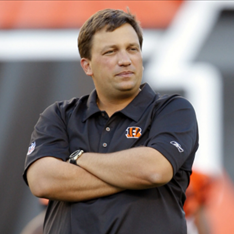
“The biggest thing now,” Cioffi said, “Is you can go get ready-made players… you don’t have to wait on their development.”
In the past, college programs were built on recruiting high school players and developing them over time. Now, with the transfer portal and NIL, coaches are evaluating players more like professionals, based on proven production rather than potential. It’s a shift that mirrors what agents like Chris Gill described: a system driven by opportunity, exposure, and value. But from a coach’s perspective, that same system comes with consequences.
“You’re basically paying college athletes to become professionals,” Cioffi said. “But the structure isn’t the same.”
In the NFL, contracts provide stability. Players sign, teams commit, and both sides are bound to a timeline. In college football, that structure doesn’t exist.
“Once you give a guy a contract in the NFL, he’s locked in,” Cioffi said. “The way college football is, that’s not the case right now.”
Instead, the transfer portal has created something closer to open-market movement without long-term security. Players can leave, but they can also be replaced just as quickly. That speed is what stood out most to Cioffi. For players like Racin Delgatty, that acceleration played out in real time, with offers appearing and disappearing within hours, and opportunities lost the moment a spot was filled. From the outside, the portal can look like freedom. From inside a program, it looks different.
“It’s a double-edged sword,” Cioffi said. “The positives are there… but at that point, you’ve now become a professional athlete.”
And like any professional system, not everyone benefits.
“There’s close to six thousand kids still available in the transfer portal,” he said. “And there’s not six thousand spots to play.”
That reality introduces risk into every decision, especially for families navigating the process for the first time.
“Once you go in,” Cioffi said, “you’re out.”
It’s a warning that echoes across the system. While agents help athletes maximize opportunity, coaches are left managing the consequences, balancing rosters, replacing players, and navigating a constantly shifting target. And for families like the Delgattys, those decisions aren’t abstract. They’re immediate. They’re personal. And they’re happening faster than ever.
“At some point,” Cioffi said, “the parents gotta be like, ‘what are we doing?’”