

After decades working for national media’s biggest names, Paul Miller “retired” to Carmel-by-the-Sea in the 1990s. But instead of spending his days soaking in Carmel’s stunning cliffsides, he did something a little closer to home: he bought a local newspaper out of destitute. Thirty years later, the Carmel Pine Cone is a well-funded, well-oiled machine that prints weekly and is free to the eager public. Miller’s Pine Cone is a shining example of the Golden State’s many thriving local news ecosystems, and a model for small-town press looking to beef up their ventures.
In September 2025, in another corner of California, Aysha Pettigrew joined the Merced Sun-Star as a California Local News Fellow. Their two year stint at the paper is funded by a UC Berkeley initiative to increase the number of journalists at local publications around the state. In November, just two months into their very first reporting gig, McClatchy Media laid off every single staffer at the Sun-Star — except them.
Thanks to the fact that Pettigrew’s salary was being paid for by the Berkeley program, and therefore not an employee that McClatchy could lay off, they and the fellowship team determined that the best idea was to have them stay and cover the community that had just lost multiple journalists. The fellowship’s purpose was now more important than ever in Merced.
“I knew that this was a possibility,” they told me. “But I was like, ‘I don’t know what my role is now.’ I was hired to be the economic mobility reporter, and I was starting to carve out my beat and find my sources … now I kind of have to cover everything.”
(Right: Aysha Pettigrew, fellow at the Merced Sun-Star. Photo courtesy of Pettigrew & design by Jennifer Nehrer)

In the same state that hosts an intrepid team of reporters covering a small town within a small county Pettigrew is a newsroom of one, covering Merced County mostly on their own. Pettigrew’s experience highlights a sometimes hidden aspect of California local journalism: all that glitters is not golden in the otherwise aptly named state.
Judging a Book by its Cover
On paper, California’s local news landscape seems to be thriving. Low-population counties in the state hold their own against some of the United States’ biggest when it comes to the ratio of people per news outlet in the area. Three of California’s smallest counties — Sierra, Modoc and Colusa — have the best ratios of people per outlet (including physical papers) in the state, and appear to be miles ahead of other major counties including DC, Cook County (Chicago), Kings and Queens Counties (New York City) and King County (Seattle). A simple set of statistical calculations paints a very positive — and significant — picture of the average Californian’s ability to get local news about their county, with the exceptions of Stutter and Alpine, which both have zero local papers.
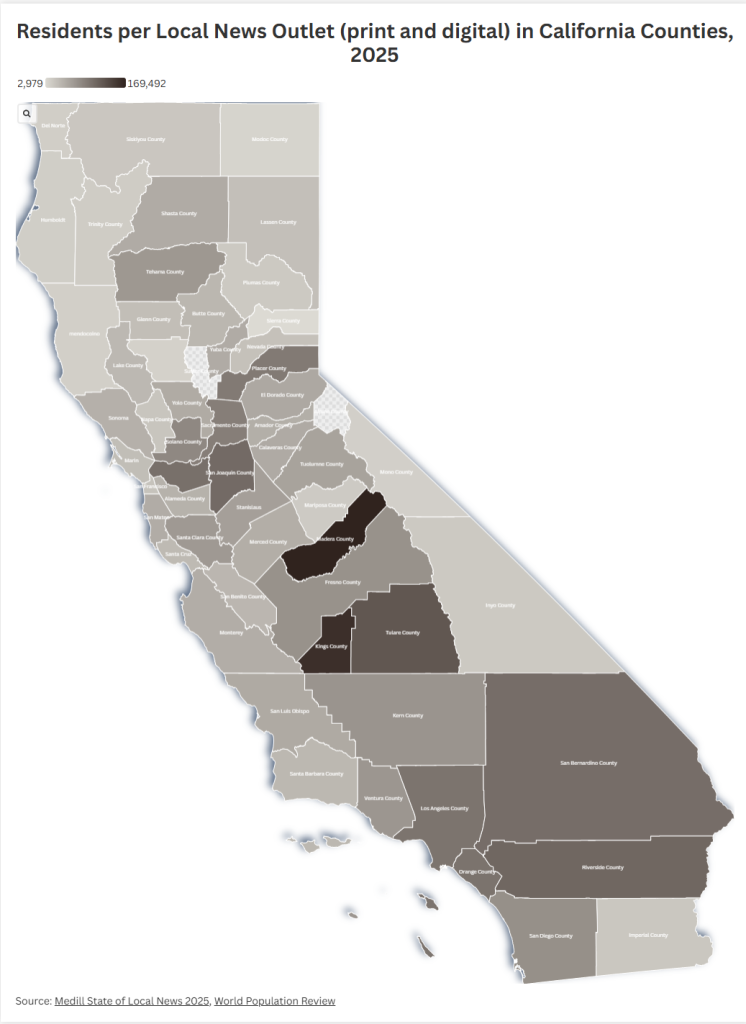
This is a picture of a graph I produced for this project showing the ratio of residents in each California county per local news outlet. Counties with larger ratios (meaning more residents per outlet) are colored darker. This does not mean a smaller ratio is a healthier local news ecosystem, but it is something to consider.
Find the full, interactive graph on the Multimedia Elements page.
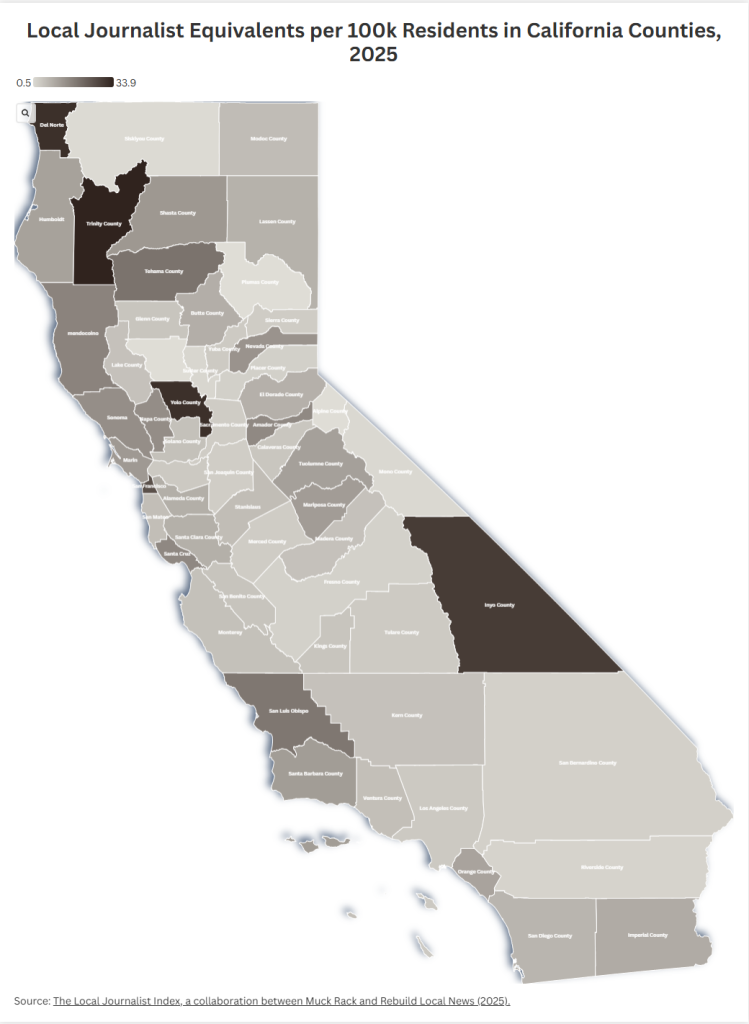
Matt Pearce, Director of Policy at Rebuild Local News, prefers to add a second statistic to present a fuller picture of who is bringing local news to California communities: RLN and Muck Rack’s “Local Journalist Index,” a tool that analyzes how many Local Journalist Equivalents there are in each US county. Local Journalist Equivalents, per the tool’s website, are representative of the amount of journalists in the area who cover almost exclusively local matters.
This is a picture of a graph I produced for this project showing the number of Local Journalist Equivalents in each California county per 100k residents, determined by Rebuild Local News and Muck Rack. Counties with larger ratios (meaning more LJEs per 100k residents) are colored darker. Larger ratios mean that the county has a larger percentage of journalists covering local matters.
Find the full, interactive graph on the Multimedia Elements page.
“The number of publications in a given location is useful for trying to establish access to information in some respects, but it may not measure production as accurately,” Pearce said of building the tool. “There are a lot of different ways of measuring the decline in local news production, local news access, and this was our particular contribution to it.”
Incidentally, California ranks near the bottom of the list for LJEs per 100,000 residents on average with just 6.1, placing it at 41st out of 50 states. Four California counties — Riverside, Fresno, San Bernardino and San Joaquin — rank among the ten lowest of US counties with populations higher than 500,000 when it comes to their LJE to population ratios. Riverside came in at second lowest with just 1.7 LJEs per 100,000 people.
Interactive: Outlets versus LJEs
This is an interactive element so you can directly compare the two graphs mentioned above. It was made using Juxtapose JS, and can also be found on the Multimedia Elements page.
The Local Journalist Index also helps explain the situation in areas like Los Angeles, where several new publications have cropped up in just the last few months. While they do provide hope for the production of hyperlocal news, Pearce said a lot of what has happened is simply a redistribution of journalists in the area from legacy outlets like the LA Times to smaller, usually philanthropic ventures. Los Angeles County’s high population means that it clocks in at 3.6 LJEs per 100,000 people, which Pearce said is on the lower end for both California and the country.
“You have this situation where there’s a multiplication of titles in the county, but it’s not merely offsetting or creating the number of new journalist jobs that have been lost in the legacy side of the sector,” Pearce said. “The number of publications, and the number of journalists and what we think of as ‘productive capacity’ are different things.”
The Video: Take a look at what’s going on with local news startups in Los Angeles
Success Stories in CA
Miller’s Pine Cone has virtually zero online presence. To read an article on your computer, the website takes you to the latest newspaper PDF file. A few ads run online, but the operation is funded entirely by its print advertising revenue. When I interviewed Miller to find out what has kept the Carmel Pine Cone up and running since he purchased it nearly 30 years ago, he chalked it up to a single guiding principle: “content is king.”
“It doesn’t matter how great a software engineer you are if you don’t write good software, it doesn’t matter how great an author you are if you don’t write good books,” said Miller, the self-proclaimed “Chief Light Bulb Changer” at the Pine Cone. “When I bought [the paper], I wanted to focus on the content, and that’s all I’ve ever done. And for some reason, the success has followed.”
Indeed, the paper averages approximately $60,000 worth of advertising revenue per week, with special issues — such as the one that was on newsstands when I spoke to Miller — bringing in $100,000. Though the ad revenue is the Pine Cone’s only source of profit, it is plenty to keep the paper printing and for Miller to pay his staff of 22 writers, editors and office employees — some of whom earn $100,000 a year. All of Miller’s staff live in Monterey County and write for the paper either full or part-time, bringing true local journalism to county residents and visitors.
To measure success at the Pine Cone, Miller doesn’t check the newsstands to see how many papers have been taken or his website analytics. Instead, he judges his success by the number of advertisers who stick with him. That, and the folder of positive reader emails he’s labeled “attaboys.”
“I haven’t ever done any marketing research,” he said. “[Advertisers] aren’t in the charity business. They’re all very hard nosed business people who are striving to make a living and send their kids to college. So if they spend $500 in the Pine Cone, they have their own reason for doing that.”
As long as the advertising pays the bills — which it does — Miller said he’ll keep doing what keeps the advertisers coming. But what works for one outlet may not work for another. Other parts of California have taken different approaches to bringing more local journalists to their newsrooms.
In Los Angeles and Del Norte, two counties that could not be more different, an alternative strategy appears. Two philanthropically-supported local news initiatives have been thriving – both utilizing young residents interested in learning the ropes of journalism to fill local reporting gaps.
Up north in Del Norte, California, the Redwood Voice is a youth-led media organization that employs high school and college-age students to help with reporting. Funded by grants from a few different nonprofits, the Voice’s staff will also be going to local middle schools to teach reporting basics and media literacy, training the next generation of Del Norte journalists. Jessica Andrews, the Voice’s news director, said she thinks this model is more effective than others in rural areas such as her own.
“Local news in California, particularly rural California, is going to be dependent on these kind of models that look outside the traditional box,” she said. “When it comes to newsgathering, we’re not necessarily relying on professional, full time reporters most of the time. Instead, we’re harnessing our youth and their energy and unique perspective.”
And down in Southern California, a similar model is present. The LA Local began in 2010 as the Boyle Heights Beat, a small newsroom in Los Angeles that teaches high school students how to report and write a story about their community. In late 2025, it re-launched as three outlets covering a larger area of the city thanks to grants from the American Journalism Project and other news-oriented philanthropies.
Claudia Koerner, Managing Editor for Neighborhoods at the LA Local, said she joined because she felt that national media didn’t have enough coverage of Los Angeles. What she said makes the LA Local stand out amongst a group of other new outlets in the area is both the focus on individual neighborhoods and the direct interactions that the initiative’s staff have with their readers.
“[Local news is] really a two way street,” she said. “We’re informing our local audience, and they’re also talking back to us about whether the coverage is landing [and] what they need to know but don’t have the answers to. That kind of relationship is much different when you’re working in national media — even if you’re getting a million views, you might not really be hearing from anyone directly about what they think about the article.”
(Right: The LA Local’s lobby with Claudia Koerner on a couch. Photo & design by Jennifer Nehrer)

Koerner said the work seems to be paying off. People have stopped by the Boyle Heights Beat office to deliver donations or offer tips about something going on in the neighborhood.
Though Los Angeles and Del Norte have two very different news ecosystems, they’ve both found a way to support their local news and community while involving the ones who will inherit it. In other areas, a more hyperlocal model requires a smaller approach.
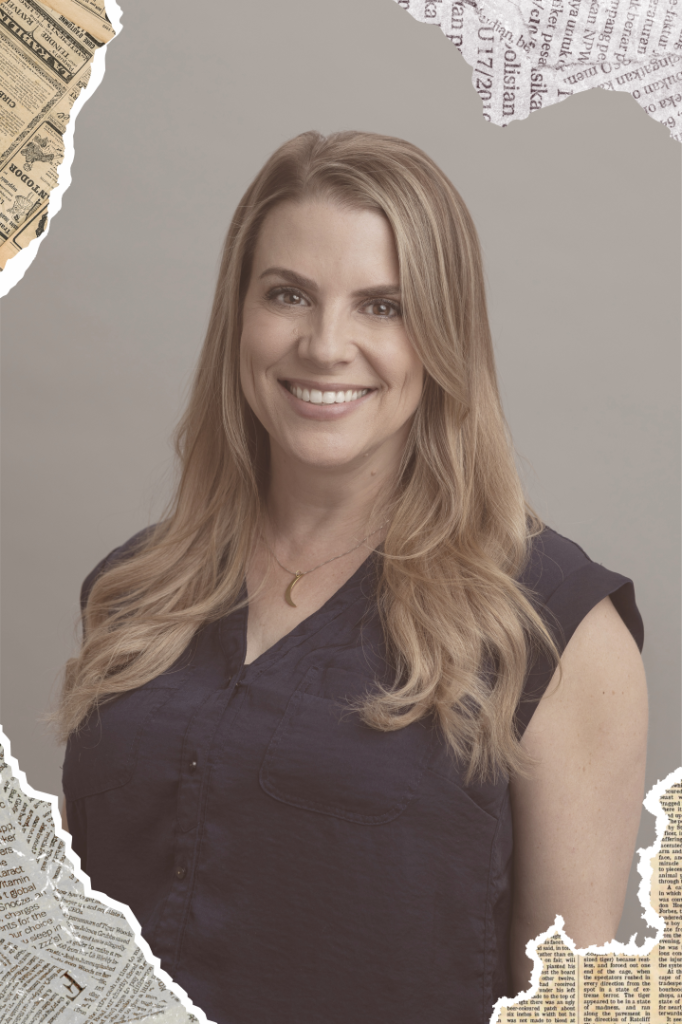
Further south, La Jolla, a town in San Diego with a population of just about 40,000, has at least three hyperlocal news outlets or subsidiaries of larger ones. Elisabeth Frausto is officially the Senior Editor at one, lajolla.ca, but she is also the only journalist working at the publication. The “interactive digital media outlet” was started by a La Jolla resident and is run by a team of four, Frausto and the founder included.
Despite covering an area with a relatively small population, lajolla.ca reaches 161,000 accounts on its Instagram — three times the population of its area of interest. Frausto attributes the strong readership and presence of so many hyperlocal outlets to a desire for community-focused journalism in San Diego.
“I know that there’s a very insatiable hunger for local news, that community journalism thrives in their communities,” she said. “And the reason I think that there can be multiple outlets in one community like La Jolla, is that people really connect to people in their community, and they’re looking for different voices … They want as many voices as possible.”
(Left: Elisabeth Frausto, senior editor at lajolla.ca. Photo courtesy of lajolla.ca & design by Jennifer Nehrer)
Though they appear in wildly different areas of the state, communities in California have found ways to build not only successful local news ecosystems, but successful local journalist ecosystems as well. But California still has work to do.
Room for Improvement
As of spring 2026, Pettigrew is still the only full-time reporter at the Merced Sun-Star, despite that it prints three times per week. They also now write as a satellite reporter for the Modesto Bee, covering stories about Merced and working from the Bee’s newsroom a few days each week — about a 40 minute drive from their home in Merced. Despite having their personal situation ironed out for the duration of the fellowship, Pettigrew faces a grim reality in their assigned city: there are never enough reporters at the Sun-Star to cover what needs to be written.
“Sometimes in cities, it feels like there’s a lot of competition for stories,” they said. “But here, sometimes I have five things I’d like to cover today, and I can only do two of them.”
This is when Pettigrew turns to two other California Local News Fellows at the Merced Focus, a nonprofit news site in the area, for help. They also get some service journalism coverage for the Sun-Star from reporters at other McClatchy-owned papers in California’s Central Valley.
Nevertheless, Pettigrew has had to adjust to a new community and outlet mostly on their own, a process which they said involved a lot of different feelings.
“It felt overwhelming to feel like I have to figure out what the important things to cover in this community are, because I’m still getting to know the community,” They said. “There are still lots of things that I don’t know about. How do I know that the story that I picked is actually the one that people care about the most, or will have an impact for people?”
Up in Humboldt County, Jennifer Cahill faces a similar problem: she is the editor-in-chief of a newspaper, the North Coast Journal, that has a total full-time staff of three. Cahill and her two other editors work out of a small office in Eureka, and every other contributor is a freelance writer who has another job. Cahill is the only one in the office who is allowed to work more than 40 hours per week, and though her official title is “managing editor,” she doesn’t feel that it reflects the newsroom’s status.
“It seems sort of weird to have the title as if we still have newsrooms with a dozen people,” she said. “It gives me that vibe of like, ‘barely managing editor,’ ‘mostly surviving editor.’”
Though her staff has always been small, this is the smallest it’s ever been after they had to lay off a fourth staffer as an emergency measure over the summer. And while the paper is now “in the black,” they still do not have enough money to take on more staff.
(Right: a screenshot of a recent cover design for the North Coast Journal. Photo courtesy of the Journal’s instagram & added design by Jennifer Nehrer)

When she asks new writers to freelance, Cahill says, “I would love to underpay you.”
The lack of funding also means that it has been difficult for Cahill to pay a more diverse set of writers for her paper, which in turn means a lack of representation for the various ethnic groups that make up Humboldt County.
“I need to have people of all different backgrounds covering material of all different backgrounds, so that we don’t just have white voices reviewing film, or we don’t just have white voices talking about art,” she said. “I think that is an invisible kind of discrimination, and I don’t want to see it.”
Interactive: Learn more about the featured journalists
This interactive element, made using Storymap JS, allows you to click through a set of slides and learn more about the journalists I spoke to for this project. Though they may not all appear in the main text piece, each provided valuable insight for my capstone and deserve to have their voices heard. You can also find this interactive on my Multimedia Elements page.
How to Make it… Maybe
Frausto said she loves working at lajolla.ca because not only is she local to the area, but so is the management. One of the reasons she had left her previous job at the La Jolla Light, owned by the same company as the San Diego Union-Tribune, is because the two papers were bought by an out-of-state owner.
“The more you remove news management from the community that it serves, whether that community is LA County, which is gargantuan, or even La Jolla, the more diluted the news and the less interesting it is to readers,” she said. “I honestly don’t think I would work in La Jolla journalism if I didn’t live here, because [it wouldn’t be] my community. My voice changes when I’m not writing about things that relate to me.”
One man has taken this philosophy to heart. TJ Montemer is 41 years old, and he considers himself to be the youngest media owner there is. But what sets him apart from other big media companies is not simply his age, it’s his model: each of the groups of papers he owns in Los Angeles, Modoc County, CA, Florida and now Mississippi acts as its own entity, both in marketing and behavior. The website for Mirror Media in Los Angeles only lists the seven local papers in that group, and no mention of other states can be found.
Montemer said he does this because to him, it doesn’t make sense to force outlets across the country to do the same thing. The same goes for the journalists who work there — each group has its own set of editors and boots on the ground.
“Every single community represents itself,” he said. “What I do in LA will not work in Modoc, what I do in California sure as shit will not work in Florida … the character or the identity of the actual company itself is always going to be derived out of the staff locally.”
Montemer embarked on this venture because he believes in the importance of local news over national media, especially as he said no longer trusts what comes out of national news nowadays.
“There’s just not enough money involved in local [news] to make it corrupt,” he said. “It’s a pure play to me. And I like that. I like pure plays. I don’t want to feel like what I’m doing doesn’t matter. I think local news matters more than anything right now.”
(Right: a screenshot of the April 24-30, 2026, issue of the Santa Monica Mirror & Yo! Venice. Photo courtesy of yovenice.com & added design by Jennifer Nehrer)

Frausto said she remains passionate about the importance and resilience of smaller, local papers because of that community focus and need.
“No matter what happens with large outlets,” she said, “community journalism will always survive, because people will always need to know and want to know what’s happening in their community, Whether that’s as small as an HOA newsletter that covers eight blocks, or a paper that’s fit for 40,000 people, or an Instagram account that reaches more than six figures of followers.”
In speaking with newsroom leaders across the state, what most emphasized was the same as Montemer and Frausto: dedicated local reporting requires a local staff and focus; though the former is what some newsrooms are struggling to pay for, and there is no “one size fits all” model for making those payments happen.
In 2021, bipartisan lawmakers in Washington, DC were lobbying their colleagues to support the Local Journalism Sustainability Act, a bill that would utilize various subsidies to financially support local news across the country. Amid the usual legislative chaos, the LJSA was for the most part abandoned, leaving individual states to pursue their own strategies — if they even wanted to do so — to fund local news.
Pearce said he has seen some states attempt their own versions of these incentives to varying degrees of success, but the issue still remains. Indeed, California has begun the process to implement such legislation on the state level through Assembly Bill 2222, or “California’s Community NEWS Act.” Introduced by Assemblymember Christopher M. Ward in February, the act would create two refundable tax credits for newsrooms that hire local journalists. The act is currently stuck in committee.
Pettigrew’s fellowship is also an example of a subsidy for local news outlets so they can strengthen their staff without worrying about the cost. Having their salary paid for by Berkeley is what allowed Pettigrew to stay with the Sun-Star when others were laid off.
In fact, Pettigrew had actually been working at UC Berkeley before becoming a fellow, and had watched the fellowship grow from its infancy. They said the fellowship has really helped these underserved communities have reporters, but also helped the reporters themselves — all of whom are early in their careers — get the training and support they need.
“I’m really impressed by the work that other fellows are doing all throughout California, and I think that a lot of these counties wouldn’t have a lot of coverage if it weren’t for the fellowship,” they said. “On top of that, the fellowship provides ongoing training and a space to talk about reporting ethics and what our goals are and what we’re working toward. And I think it’s really helpful to feel like you’re part of something like that.”
Pettigrew’s situation also demonstrates, however, that this subsidy could simply be a band-aid over a bullet hole. McClatchy still pulled the Sun-Star’s funding, leaving Pettigrew in the situation they find themself in today.
If there’s one thing this analysis should highlight, it’s that there actually is no one-stop solution to a lack of local journalists in any given California newsroom. California is a diverse state in many ways, and this is no exception. The outlets here are from areas wealthy and poor, urban and rural, coastal and inland, populous and not. The solutions for the crisis must therefore be as diverse and localized as the communities that each of these papers serve, and to insinuate otherwise would be doing a disservice to the good they aim to bring to their readers.